
Salesforce Agentforce is Salesforce's platform for building, deploying and governing AI agents that can understand a request, reason about it, use company data and take action inside business processes, from answering customer questions to updating records and routing cases. First introduced in October 2024, it has since grown into the Agentforce 360 platform. This guide explains what Agentforce is, how its agents work, the building blocks, use cases, the data and security requirements, and how to get ready to adopt it.
Short answer: Agentforce lets you configure AI agents that work inside Salesforce. You give an agent a role, the topics it may handle, the actions it may take and the data it may use. The platform supplies the reasoning, the trust controls and the monitoring.
What is Salesforce Agentforce?
Salesforce describes Agentforce as its agentic AI platform. Where a chatbot follows a script and a copilot suggests text for a person to approve, an agent is designed to complete tasks. It reads the request, decides which steps are needed, calls the right tools and reports the result, within limits you define.
The platform has moved quickly. Salesforce introduced Agentforce in October 2024, improved its reasoning engine in a second release that December and launched Agentforce 360 at Dreamforce in October 2025, adding a conversational builder, a scripting language for agent behaviour and hybrid reasoning that mixes fixed workflow steps with flexible model reasoning. Check Salesforce's release notes for the current feature set, because capabilities and names continue to change.
How Agentforce works
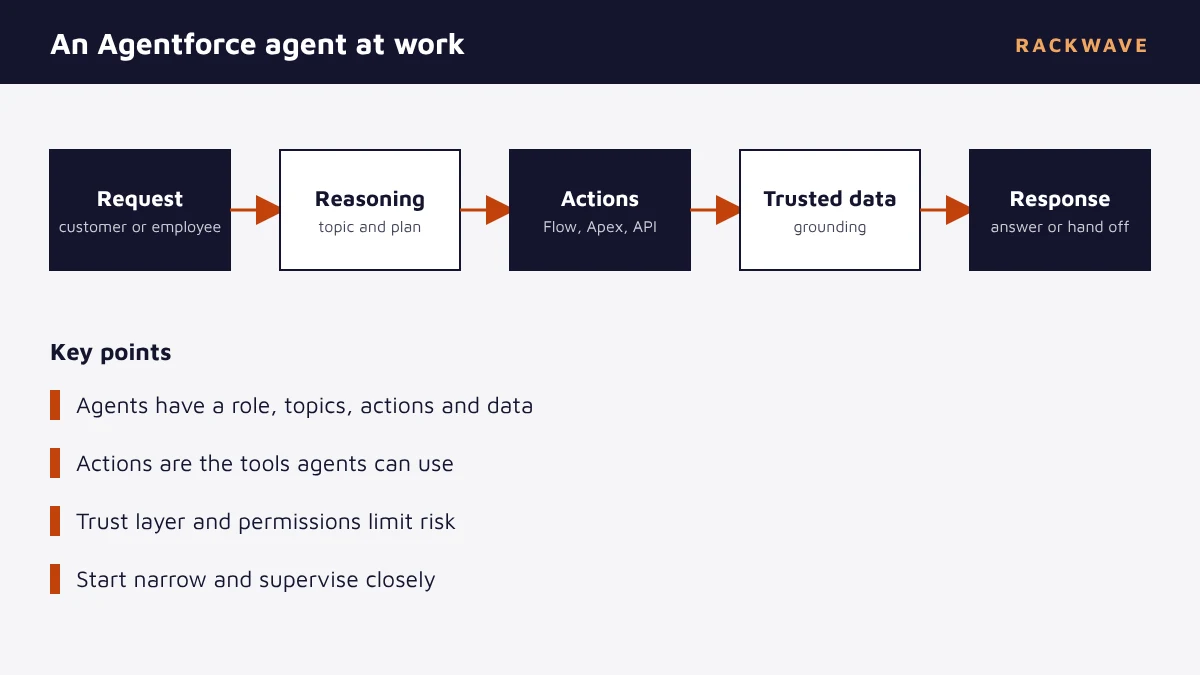
- A request arrives. From a customer on a web chat, messaging channel or voice line, or from an employee in Slack or a Salesforce app.
- The agent reasons. The reasoning engine interprets the intent and picks the matching topic, the area of work the agent is allowed to handle.
- The agent plans actions. Within a topic it selects actions, such as running a Flow, calling an Apex method, querying records or invoking an API.
- The agent grounds the answer. It retrieves relevant company data, such as customer records and knowledge articles, so the answer reflects your facts.
- The trust layer checks. Masking, toxicity checks and audit logging apply to the prompt and the response.
- The agent responds or hands off. It answers, completes the action or escalates to a person with the full context.
The building blocks of an Agentforce agent
| Building block | What it is | Example |
|---|---|---|
| Role and instructions | Plain-language description of who the agent is and how it behaves | "You are a returns assistant for an electronics retailer." |
| Topics | Categories of work the agent can handle, each with its own instructions | Order status, returns, warranty |
| Actions | Tools the agent can run | A Flow that issues a return label, an Apex method, an API call |
| Data | Records, knowledge and external data the agent can use | Cases, orders, knowledge articles, unified profiles |
| Guardrails | Rules that limit what the agent may say or do | Do not offer refunds above a set value |
| Channels | Where the agent runs | Web chat, messaging, voice, Slack, email |
Actions are where existing Salesforce skills matter. A well-built Flow or an Apex method becomes a reliable tool an agent can use, with the same validation and permissions as any other automation.
Agentforce and data: why Data 360 matters
An agent is only as useful as the data it can see. Salesforce positions its unified data layer, called Data Cloud and renamed Data 360 in 2025, as the source of context for agents. It brings customer data from many systems into unified profiles, and makes unstructured content such as documents and transcripts searchable. Read our guide to Salesforce Data Cloud for how that layer is built.
An agent with poor data does not fail loudly. It answers confidently and wrongly. Data quality is the first deployment task, not the last.
Agentforce use cases
| Area | Example agent task | Salesforce product area |
|---|---|---|
| Customer service | Answer questions, check order status, process returns, escalate with context | Service Cloud. See Service Cloud |
| Sales | Research accounts, draft outreach, update records, qualify inbound leads | Sales Cloud. See Sales Cloud |
| Marketing and commerce | Personalise offers, answer shopper questions, guide purchases | Marketing and Commerce Clouds |
| Employee support | Answer HR and IT questions inside Slack | Slack and the platform |
| Operations | Process requests, route work and trigger approvals | Platform and Flow |
Start with a narrow, high-volume task where the correct answer is clear, such as order status or appointment changes. Agents perform best when their job is well defined and the data and actions behind it are reliable.
Trust, security and governance
Enterprises worry about two things: what the model may reveal and what the agent may do. Salesforce addresses the first with the Einstein Trust Layer, which includes dynamic grounding, data masking, zero data retention agreements with model providers and toxicity detection, according to its documentation. The second is addressed by guardrails and by the Salesforce permission model, since an agent acts with defined access, not unlimited access.
- Give each agent the least access it needs, using permission sets and a dedicated running user.
- Write explicit limits in instructions and enforce them in the actions, not only in the prompt.
- Test with adversarial and ambiguous requests before launch.
- Log conversations and review samples regularly.
- Keep a clear human handoff for anything sensitive or uncertain.
For stronger data protection, see our guide to Salesforce Shield, and for the wider AI feature set, Einstein AI.
Integrating agents with other systems
Useful agents rarely live only in the CRM. They need order data from an ERP, entitlement data from billing and shipping status from a logistics system. Those connections are exposed to agents as actions, usually through APIs. Salesforce has also introduced MuleSoft Agent Fabric to register, govern and monitor agents across platforms. If your data sits in many systems, plan the integration layer early, using the patterns in our Salesforce integration guide and what is MuleSoft.
How to get ready for Agentforce
- Choose one use case. Pick a contained, high-volume task with a measurable outcome.
- Check data quality. Clean and unify the data the agent will use, and fix gaps in knowledge articles.
- Build the actions first. Create and test the Flows, Apex methods and integrations the agent will call.
- Write topics and instructions. Be specific about scope, tone, limits and when to hand off.
- Test in a sandbox. Use real examples, edge cases and attempts to push the agent out of scope.
- Launch with supervision. Start with a limited audience and review conversations daily.
- Measure and extend. Track resolution, handoff rate and satisfaction before adding topics.
Practical tip: Treat an agent like a new employee. Give it a clear job description, limited access, training material and a manager who reviews its work in the first weeks.
Common mistakes
- Launching a broad "answer anything" agent instead of a focused one.
- Ignoring data quality and outdated knowledge articles.
- Putting rules only in the prompt and not in the actions.
- Skipping testing for unusual or hostile requests.
- Measuring deployment, not outcomes such as resolution and customer satisfaction.
- Forgetting change management for the staff who work alongside the agent.
Our Salesforce consulting and AI and machine learning services help teams choose use cases, prepare data, build the actions and run a safe pilot.
Key takeaways
- Agentforce is Salesforce's platform for building and governing AI agents that act, not only chat.
- Agents are defined by a role, topics, actions, data and guardrails.
- Reliable Flows, Apex and APIs become the tools an agent uses.
- Data quality, permissions and testing decide whether an agent is safe and useful.
- Start narrow, supervise closely and expand once outcomes are proven.
Quick glossary
| Term | Meaning |
|---|---|
| Agent | An AI system that reasons and takes actions to complete tasks |
| Topic | A category of work an agent handles, with its own instructions |
| Action | A tool the agent can run, such as a Flow or API call |
| Grounding | Supplying trusted company data to the model |
| Einstein Trust Layer | Salesforce controls for masking, safety and data handling |
Read next: Salesforce Integration: Patterns, APIs and Best Practices · Salesforce Apex: What It Is, Triggers, Limits and Best Practices · Salesforce Data Cloud (Data 360): What It Is and How It Works
Frequently asked questions
What is Salesforce Agentforce?
Agentforce is Salesforce's platform for building, deploying and governing AI agents that understand requests, use company data and take actions such as updating records or answering customers within defined limits.
What is the difference between Agentforce and a chatbot?
A traditional chatbot follows scripted flows. An Agentforce agent uses a reasoning engine to interpret intent, choose among allowed topics and actions and complete tasks, within guardrails you set.
What can Agentforce agents do?
They can answer customer questions, check orders, process returns, research accounts, draft outreach, qualify leads, update records and handle employee requests, depending on the actions and data you give them.
Does Agentforce need Data Cloud?
Agents can use data in your Salesforce org, but unified, high-quality data gives better answers. Salesforce positions Data Cloud, now called Data 360, as the context layer for agents. Check current requirements for your edition.
Is Agentforce secure?
Salesforce provides the Einstein Trust Layer with masking, grounding and safety checks, and agents run under defined permissions. You still need least-privilege access, testing and monitoring.
How much does Agentforce cost?
Pricing is consumption-based and has changed over time, so check Salesforce's current pricing page or your account team. Estimate expected volumes of conversations and actions before committing.
Do I need developers to use Agentforce?
Admins can configure many agents with low-code tools, but the actions an agent calls are often Flows, Apex or integrations, so development and integration skills are usually involved.
How do I start with Agentforce?
Choose one narrow, high-volume use case, prepare the data, build and test the actions, write clear instructions, test in a sandbox and launch to a small audience with close monitoring.