
Salesforce Data Cloud, now marketed by Salesforce as Data 360, is a customer data platform that connects data from many systems and turns it into unified customer profiles you can use across sales, service, marketing and AI. This guide explains what it does, how data moves through it, where it fits with a CRM and what to plan before you implement it.
Short answer: Data Cloud ingests data from Salesforce and external sources, maps it to a common model, resolves identities into one profile per person, and makes the result available for segmentation, activation, analytics and AI. Salesforce renamed it Data 360 in 2025, so you will see both names.
What is Salesforce Data Cloud?
A customer data platform (CDP) collects customer data from different sources and builds a persistent, unified profile of each person. Salesforce Data Cloud is Salesforce's CDP and real-time data layer. It is built into the Salesforce platform, so unified profiles and segments can drive Flow automation, Marketing Cloud journeys, service experiences and AI agents.
The product has carried several names over the years, including Customer 360 Audiences, Salesforce CDP and Genie. Salesforce's own Data 360 page now describes it as the real-time data engine for the platform. The concepts in this guide apply under either name.
How Data Cloud works
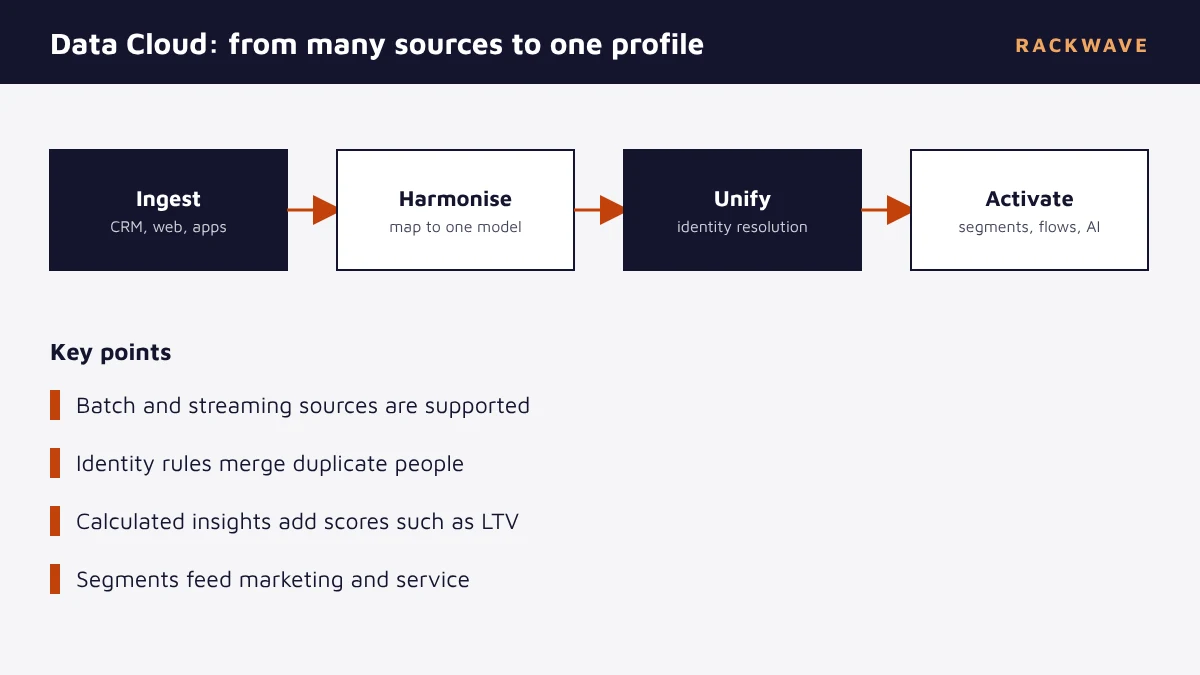
- Ingest. Connect Salesforce clouds, websites, mobile apps, cloud storage and data warehouses. Both batch and streaming ingestion are supported.
- Harmonise. Map incoming fields to the Data Cloud data model so that data from different systems means the same thing.
- Unify. Identity resolution rules match records that refer to the same person, such as the same email or phone, into a unified profile.
- Enrich. Calculated insights add values such as lifetime value, engagement score or last purchase date.
- Activate. Segments are published to marketing channels, advertising platforms, Flow automations and other systems.
Key concepts
| Concept | What it means |
|---|---|
| Data stream | A connection that brings data from one source into Data Cloud |
| Data lake object (DLO) | Raw ingested data stored as it arrives |
| Data model object (DMO) | Harmonised data mapped to a standard customer model |
| Identity resolution | Rules that match and merge records into a unified individual |
| Calculated insight | A metric computed across unified data, such as lifetime value |
| Segment | A group of profiles that match defined criteria, ready for activation |
| Zero-copy access | Querying data in platforms such as Snowflake or Databricks without duplicating it |
What can you do with Data Cloud?
- Personalised marketing: build segments from unified behaviour and purchase data, then activate them through Marketing Cloud journeys.
- Smarter service: give agents a full view of the customer's history across channels.
- Real-time triggers: start a Flow when a profile or insight changes.
- AI grounding: give AI agents trusted customer context drawn from unified data.
- Analytics: share profiles and insights to your data warehouse for reporting.
Data Cloud vs CRM vs data warehouse
| System | Best at | Limits |
|---|---|---|
| CRM (Sales or Service Cloud) | Managing records and processes for known customers | Not designed to unify anonymous and cross-channel data at scale |
| Data Cloud / CDP | Unifying profiles from many sources for activation | Not a general-purpose analytics warehouse |
| Data warehouse | Large-scale storage and analytics across the business | Not built for real-time activation by itself |
These systems complement each other. A common design keeps the CRM as the system of record for relationships, the warehouse for deep analytics, and the CDP as the activation layer. Our data warehousing and CDP consulting teams design these architectures.
A customer data platform is only as good as the identity rules and data quality behind it. Technology does not fix an unclear data strategy.
Planning a Data Cloud implementation
- Start with use cases. Pick two or three outcomes, such as win-back campaigns or abandoned-cart journeys, and work back to the data they need.
- Audit your sources. List each system, owner, update frequency, identifiers and consent status.
- Design the model and identity rules. Decide which keys match people across systems and how conflicts are resolved.
- Build and test in stages. Ingest one source, validate the profile, then add the next.
- Govern from day one. Define consent handling, retention, access and naming standards. See what is data governance.
Mind consent and privacy. Unifying personal data increases your obligations under laws such as GDPR and India's DPDP Act. Record consent per channel, honour opt-outs everywhere the profile is used and limit access by role.
Common challenges
- Poor source data. Duplicates and missing identifiers weaken identity resolution.
- Scope creep. Trying to ingest every source before proving one use case.
- Unclear ownership. Without a data owner, rules and mappings drift.
- Cost surprises. Pricing is consumption-based, so estimate data volume and usage before committing.
Related guides: what is Salesforce for the wider platform, and Salesforce integration for connecting source systems.
Data Cloud use cases by industry
Retail and e-commerce: combine web browsing, order history and loyalty data to trigger abandoned-cart, replenishment and win-back journeys. A unified profile avoids sending a discount to someone who just bought at full price in store.
Financial services: bring together product holdings, service interactions and digital behaviour to spot cross-sell opportunities and service risks, with strict consent and access controls.
Travel and hospitality: connect bookings, loyalty status and on-trip behaviour so every touchpoint reflects the guest's history.
Health and education: unify engagement and service data to coordinate outreach, provided privacy rules for sensitive data are followed carefully.
Data quality comes first
Identity resolution can only match what the data allows. If email addresses are missing, phone numbers use mixed formats or names are entered inconsistently, the result is fragmented profiles or, worse, wrongly merged ones. Before ingesting a source, profile it: count nulls, check duplicate rates and standardise formats. Our guide to ETL pipelines covers the transformation steps that usually come before ingestion.
Plan monitoring as well. Track ingestion failures, the share of profiles with a match, and segment sizes over time. Sudden changes usually indicate a broken source or a changed field, and catching them early prevents bad data from reaching campaigns.
Measuring success
- Share of customers with a unified profile across at least two sources.
- Segment build time compared with the manual process it replaced.
- Campaign performance for unified-profile segments versus legacy lists.
- Time agents spend finding customer history.
- Reduction in duplicate or conflicting customer records.
Data Cloud and AI
Salesforce positions Data Cloud as the data foundation for its AI agents. An agent that answers a customer needs context: orders, cases, preferences and recent activity. Data Cloud supplies a unified view, so the agent works from current facts instead of guesses. That raises the stakes on data quality and consent: an AI that acts on wrong or unauthorised data can do damage faster than a person could.
Before enabling AI features on unified data, review which fields are exposed, who can query them and how outputs are logged. Start with low-risk use cases, such as summarising a case history, and extend as you build confidence.
Questions to ask before you buy
- Which two or three use cases will pay back first?
- How many sources and how much data will be ingested each day?
- Which identifiers can reliably match people across systems?
- Who owns data quality and consent records?
- What is the expected consumption cost at our volumes?
- Which downstream tools will use the segments?
Key takeaways
- Data Cloud, also called Data 360, unifies customer data into profiles.
- Identity resolution quality depends on source data quality.
- Start with two or three use cases and add sources in stages.
- Consent and governance must be designed in, not added later.
- Pricing is consumption-based, so estimate volumes early.
Quick glossary
| Term | Meaning |
|---|---|
| CDP | Customer data platform that unifies customer profiles |
| Harmonisation | Mapping different source fields to one data model |
| Activation | Sending segments to channels and systems |
| Zero copy | Accessing external data without duplicating it |
Read next: Salesforce Agentforce: What It Is and How It Works · Salesforce Integration: Patterns, APIs and Best Practices · Salesforce Apex: What It Is, Triggers, Limits and Best Practices
Frequently asked questions
What is Salesforce Data Cloud?
Salesforce Data Cloud is a customer data platform built into Salesforce. It ingests data from many sources, unifies it into one profile per customer and makes it available for marketing, service, analytics and AI.
Is Data Cloud the same as Data 360?
Yes. Salesforce renamed Data Cloud to Data 360 in 2025. The product and its core capabilities are the same, so documentation and training may use either name.
What is a customer data platform?
A customer data platform collects and unifies customer data from different systems into persistent profiles that other tools can use for personalisation and analysis.
Do I need Data Cloud if I already have Salesforce CRM?
Not always. CRM holds known customer records, while Data Cloud is for unifying data across many sources and channels. It is most valuable when you have fragmented data and want real-time activation.
What is identity resolution?
Identity resolution matches records from different sources that refer to the same person, using rules based on keys such as email or phone, and merges them into a unified profile.
What is zero-copy integration?
Zero-copy lets Data Cloud query data stored in platforms such as Snowflake or Databricks without copying it, which reduces duplication and delay.
How is Data Cloud priced?
Salesforce describes pricing as consumption-based, so you pay for the services you use. Estimate data volume and processing needs and confirm current terms with Salesforce or a partner.
How long does a Data Cloud implementation take?
A focused first use case can be live in weeks, while a multi-source programme with governance takes months. Source data quality and identity rules are the main drivers.