
Lead generation is the process of attracting people who might buy from you and capturing their interest and contact details so that sales or marketing can follow up. It is the front door of the revenue engine: without a steady flow of relevant leads, even the best sales team has nobody to talk to. This guide explains what lead generation is, the main B2B and B2C channels, how to build a lead generation programme step by step, how to qualify and route leads, which metrics prove it is working, how to use your CRM to avoid losing leads and the mistakes that fill pipelines with names that never buy.
Short answer: Lead generation works when you know exactly who you want, offer something valuable in exchange for their details, capture leads in a CRM, respond quickly and qualify them against clear criteria. Measure cost per qualified lead and revenue per source, not just the number of form fills.
What is lead generation?
A lead is a person or organisation that has shown some interest in what you offer, whether by downloading a guide, requesting a demo, replying to outreach or attending an event. The discipline of attracting them is described in the lead generation article on Wikipedia. Generating leads is only the first step. They must then be managed, nurtured and passed to sales at the right moment, topics we cover in lead management and lead nurturing.
Inbound vs outbound lead generation
| Approach | How it works | Typical channels | Strength |
|---|---|---|---|
| Inbound | Attract people who are already looking and let them come to you | Search, content, webinars, social, referrals. See inbound marketing | Higher intent, lower cost over time |
| Outbound | Reach out to defined target accounts proactively | Email, calls, LinkedIn, events, direct mail | Speed and control over who you reach |
| Paid | Buy attention to accelerate volume | Search ads, social ads, sponsorships | Immediate scale, needs good tracking |
| Partner and referral | Earn introductions through relationships | Partners, customers, communities. See referral marketing | Strong trust and conversion |
Lead generation channels and what they suit
| Channel | Best for | Watch out for |
|---|---|---|
| Search engine optimisation and content | Long-term, compounding, high-intent leads | Slow to start; needs quality and consistency |
| Paid search | Capturing active demand quickly | Rising costs; weak landing pages waste spend |
| LinkedIn and social | B2B targeting by role and industry | Low-quality leads if the offer is generic |
| Webinars and events | Building trust and qualifying interest | Attendance does not equal intent |
| Email outreach | Targeted account-based contact | Deliverability, consent and relevance rules |
| Partner and referral programmes | High-trust introductions | Needs clear incentives and tracking |
| Website forms and chat | Capturing visitors already interested | Long forms reduce conversion |
A lead is not a name on a list. It is a person with a problem you can solve, who has told you so.
How to build a lead generation programme
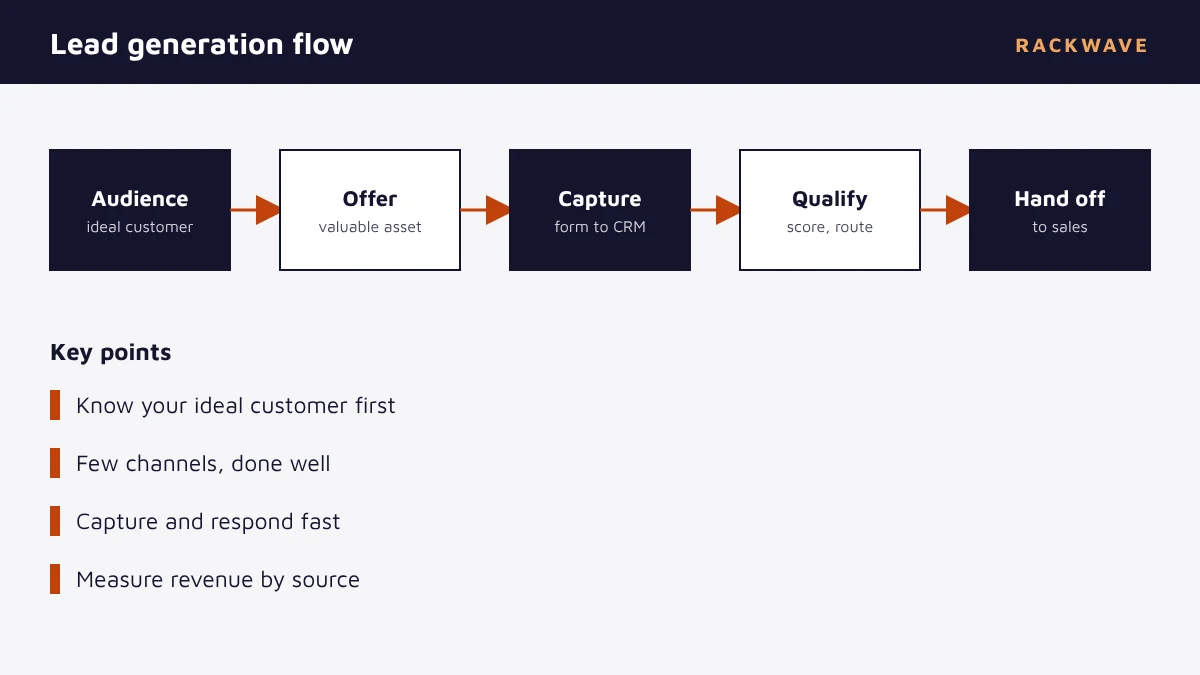
- Define your ideal customer. Write down industry, size, role, problem and trigger events. See buyer persona.
- Choose a few channels. Pick two or three where your buyers already spend time and master them before adding more.
- Create a valuable offer. A guide, tool, template, assessment or consultation that solves a real problem, not a generic brochure.
- Build focused landing pages. One offer, one message, one short form and no distracting navigation.
- Capture everything in the CRM. Record source, campaign and consent so you can attribute revenue later. See CRM software.
- Qualify and score. Use clear criteria so sales spends time on the right leads. See lead scoring.
- Respond fast. Route new leads to an owner immediately and agree a response-time target.
- Measure and improve. Report by channel from first touch to closed revenue and move budget toward what works.
Qualifying and routing leads
Not every lead is ready to buy, and treating them all alike wastes effort. A marketing qualified lead meets fit and engagement criteria set by marketing, and a sales qualified lead has been confirmed by sales as a real opportunity. Agreeing those definitions, and the hand-off rules between them, removes the most common argument between the two teams. See MQL vs SQL.
- Fit: does the company or person match your ideal customer profile?
- Intent: have they asked for a demo or pricing, or only read an article?
- Timing: is there a project, budget or deadline?
- Routing: assign by territory, product or account owner automatically, using CRM rules.
- Service level: agree how quickly each lead type must be contacted.
Lead generation metrics
| Metric | What it tells you |
|---|---|
| Leads by source and campaign | Which channels produce volume |
| Lead-to-opportunity rate | Quality of leads, not just quantity |
| Cost per lead and per qualified lead | Efficiency of spend |
| Time to first contact | Responsiveness, which strongly affects conversion |
| Pipeline and revenue by source | Real return on each channel |
| Customer acquisition cost | Total cost to win a customer. See customer acquisition cost |
Avoiding common lead generation mistakes
- Chasing volume with broad offers that attract students and researchers, not buyers.
- Sending every form fill straight to sales without qualification.
- Losing leads between the website, marketing tool and CRM because the systems are not integrated.
- Failing to record the source, so budget decisions rest on guesses.
- Letting leads wait days for a response.
- Ignoring consent and privacy rules in email and data collection.
Using automation and your CRM
Automation makes lead generation scalable without making it cold. Forms feed the CRM directly, routing rules assign owners, tasks remind reps to follow up and nurture sequences keep contacts warm until they are ready. Our marketing automation guide explains the building blocks, and our CRM and lifecycle service designs the data model, scoring and routing on HubSpot, Salesforce or Dynamics 365.
A worked example: improving lead quality
A consulting firm receives 300 enquiries a month from a generic "contact us" form, yet only 15 become real opportunities. Analysis shows most enquiries come from job seekers and students. The team replaces the form with a short qualification step asking company size and project type, publishes a pricing guide aimed at buyers and adds a rule that routes large-company enquiries to senior consultants within an hour. Total enquiries drop to 180, but real opportunities rise to 30. Cost per qualified lead falls by roughly half. The lesson is that a smaller number of better leads beats a large number of poor ones, and that the data to prove it lives in the CRM.
Lead generation for different business types
| Business type | What usually works | Why |
|---|---|---|
| High-value B2B services | Account targeting, thought leadership, referrals, events | Few buyers, long cycles, trust matters most |
| SaaS and software | Content, product-led trials, comparison pages, webinars | Buyers research alone before talking to sales |
| E-commerce and consumer | Search, social, email capture, loyalty sign-ups | High volume and fast decisions. See e-commerce expertise |
| Financial services | Calculators, advisory content, partner channels. See banking and lending work | Trust and compliance shape the journey |
| Healthcare and education | Information content, appointment or enquiry forms. See healthcare expertise | Sensitive decisions need clear, reassuring information |
Landing pages and forms that convert
Most lead generation is won or lost on the page where someone decides to share their details. Keep the promise on the page identical to the promise in the advertisement or link that brought them. Lead with one clear benefit, show proof such as a customer logo or short quote, and ask only for the information you will really use. Every extra field lowers conversion, so start with name, work email and one qualifying question, and gather the rest later through progressive profiling. Test one change at a time, such as the headline, the button text or the form length, and give each test enough traffic to be meaningful. Finally, check the thank-you page: it should confirm what happens next and offer a useful second step, because that moment of attention is valuable.
- One offer and one call to action per page.
- Fast loading and fully usable on mobile.
- A clear privacy statement and consent where required.
- A confirmation email sent immediately, with the promised resource.
Key takeaways
- Lead generation attracts and captures people who may buy.
- Define your ideal customer first, then choose a few channels and master them.
- Capture, score, route and respond quickly using CRM rules.
- Measure cost per qualified lead and revenue by source, not just volume.
- Agree marketing and sales definitions so hand-offs work.
Quick glossary
| Term | Meaning |
|---|---|
| Lead | A person or company showing interest |
| MQL | A lead that meets marketing qualification criteria |
| SQL | A lead accepted by sales as a real opportunity |
| Lead magnet | A valuable offer exchanged for contact details |
| ICP | Ideal customer profile |
Read next: Voice of Customer: Sources, Programme and Examples · Omnichannel Marketing: Strategy, Examples and Technology · RFM Analysis: Scoring, Segments and Marketing Use
Frequently asked questions
What is lead generation?
Lead generation is attracting people who may buy and capturing their interest and contact details so marketing and sales can follow up and turn them into customers.
What are the best lead generation channels?
It depends on your audience. Common channels are search and content, paid search, LinkedIn, webinars, email outreach, partners and referrals. Start with two or three and measure by revenue.
What is the difference between inbound and outbound lead generation?
Inbound attracts people already looking through content and search. Outbound proactively contacts defined target accounts through email, calls or social outreach.
How do you generate B2B leads?
Define your ideal customer, create valuable offers, use focused landing pages, capture leads in a CRM, qualify and route them quickly and measure revenue by source.
What is a lead magnet?
A lead magnet is a valuable resource, such as a guide, template, tool or assessment, offered in exchange for contact details.
How do you measure lead generation success?
Track leads by source, lead-to-opportunity rate, cost per qualified lead, time to first contact, pipeline and revenue by source, and customer acquisition cost.
How many leads do I need?
Work backwards from your revenue target using your conversion rates from lead to opportunity to customer and your average deal size.
Why are my leads poor quality?
Typical causes are broad offers, no qualification, wrong channels, poor targeting and slow follow-up. Tighten the offer, add qualification and score leads against fit and intent.