
Referral marketing is a strategy that encourages existing customers, partners and advocates to recommend your business to people they know, usually supported by a structured programme that tracks introductions and rewards successful ones. Because recommendations come from trusted people, referred customers typically convert more easily, cost less to acquire and often stay longer than those from cold channels. This guide explains what referral marketing is, how it differs from word of mouth and affiliate marketing, the types of referral programme, how to design and launch one, how to track and reward referrals in your CRM, the metrics that matter and the mistakes that produce few referrals despite generous incentives.
Short answer: Referral marketing works when you make it easy for happy customers to recommend you, at the moment they feel most satisfied, with a clear, fair reward and automatic tracking. Ask the right customers, keep the process simple, and measure referred customer quality, not just volume.
What is referral marketing?
Word of mouth happens whether or not you plan for it. Referral marketing turns it into a managed, measurable process. The idea of recommendation as a marketing force is described in the word-of-mouth marketing article. In B2B, referrals might come from customers, partners or advisers, and in consumer markets from friends and family, often through shareable links and codes.
Referral marketing vs word of mouth vs affiliate marketing
| Approach | How it works | Control and tracking |
|---|---|---|
| Word of mouth | Organic recommendations | Hard to track or direct |
| Referral marketing | Structured programme asking customers to introduce others | Tracked, rewarded, measurable |
| Affiliate marketing | Publishers and partners promote for commission | Tracked, usually performance-based and broader reach |
Types of referral programme
| Type | Description | Best for |
|---|---|---|
| Customer to customer, consumer | Share a link or code for a reward on both sides | E-commerce, apps, subscriptions |
| Customer to business, B2B | Customers introduce peers; rewards may be credit, services or donations | Software and services |
| Partner and channel referrals | Partners recommend your services in return for fees or reciprocity | Consulting, technology, finance. See banking and lending work |
| Employee referrals | Staff introduce customers or candidates | Professional services |
| Advocacy and ambassador | Highly engaged customers promote you publicly | Brands with active communities |
Customers refer you when they are proud to, not because you offered a discount. The incentive only removes the last bit of friction.
How to design a referral programme
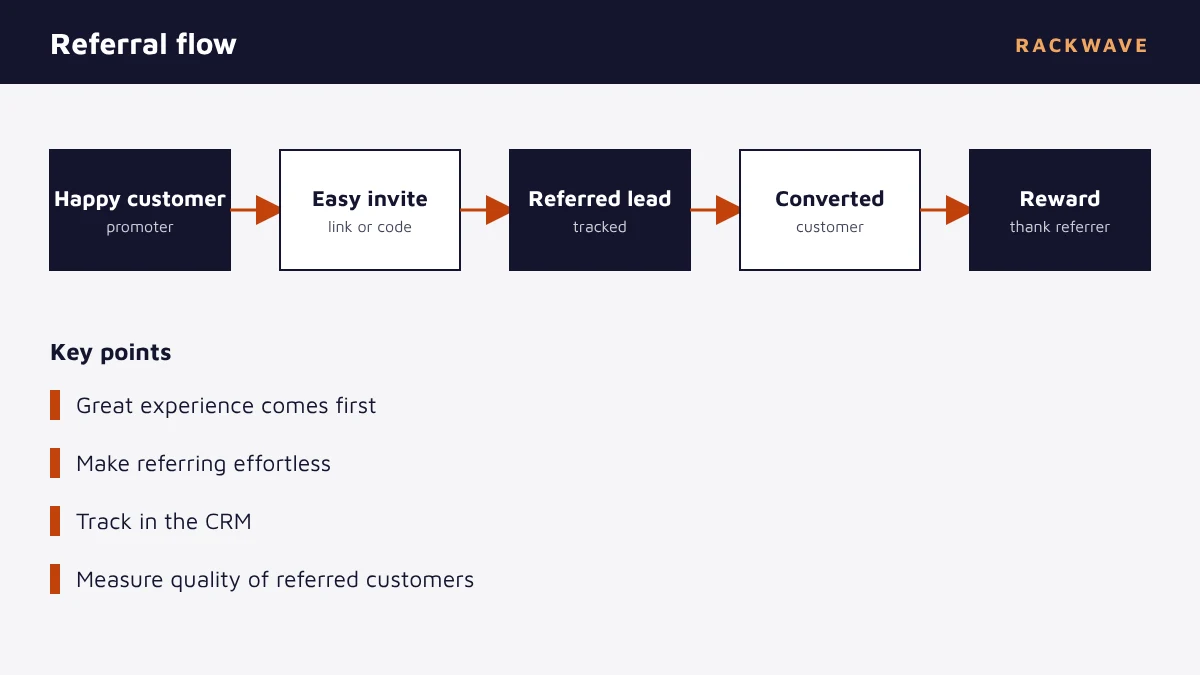
- Start with a great experience. Referrals come from satisfied customers. Check your net promoter score and fix major problems first.
- Identify likely referrers. Use CRM data to find promoters, long-standing customers and active users. See customer loyalty.
- Choose the reward. Match it to your audience: credit, discounts, extra features, donations or recognition. Consider rewarding both parties.
- Make referring effortless. Provide a personal link, code or a one-click email introduction, and a simple landing page for the new contact.
- Pick the right moment. Ask after a success, a positive survey response or a renewal.
- Track everything in the CRM. Record who referred whom, status and reward, so credit is automatic. See lead management.
- Follow up quickly. Treat referred leads with priority and thank the referrer.
- Measure and improve. Test messages, timing and rewards, and review the quality of referred customers.
How referral marketing uses your CRM
Without tracking, a referral programme becomes a manual process that frustrates both sides. A CRM should store the referral source on each lead, link it to the referring customer, record status and calculate rewards. Automation can send a thank-you when a referral is submitted, alert sales to follow up within hours and update the referrer on progress. Segmenting customers by satisfaction and engagement helps you ask the right people at the right time. Our CRM and lifecycle service designs referral tracking and journeys on HubSpot, Salesforce and Dynamics 365, and links them to lifecycle marketing programmes.
Referral marketing metrics
| Metric | What it shows |
|---|---|
| Participation rate | Share of customers who refer |
| Referral conversion rate | Share of referred leads who become customers |
| Cost per referred customer | Efficiency compared with other channels. See customer acquisition cost |
| Referred customer retention and value | Quality of referred customers. See customer lifetime value |
| Share of new customers from referrals | Programme contribution |
| Time to first referral | Whether the ask is well timed |
Referral marketing examples
| Sector | Example |
|---|---|
| E-commerce | Share a code; both friend and referrer receive credit. See e-commerce expertise |
| SaaS | Free months or extra features for each referred team. See SaaS expertise |
| Financial services | Referral bonus or fee-free period for introductions. See banking and lending work |
| Professional services | Partner network introductions with reciprocal referrals |
| Healthcare and wellness | Recommendation of services among patients, where rules permit. See healthcare expertise |
Rules, compliance and ethics
Referral schemes are subject to consumer protection, advertising and, in some sectors, financial and healthcare rules. Make sure referred contacts have consented to be contacted, disclose rewards where required and avoid rewarding behaviour that breaches regulations or platform terms. In B2B, check that employees can accept rewards under their own organisation policies, which may prohibit gifts. Keep terms short and clear, and honour rewards promptly. Reputation is the asset that makes referral marketing work, and it is easily damaged by confusing or unfair programmes.
Common referral marketing mistakes
- Launching before the product or service experience is strong.
- Making customers fill in forms or find codes.
- Offering a reward that does not suit the audience.
- Not tracking referrals automatically, causing disputes.
- Asking everyone at the same time instead of at moments of satisfaction.
- Failing to follow up quickly with referred leads.
A short example
A specialist IT services firm wins most of its work through introductions but has no system for them. It identifies clients who gave high satisfaction scores, sends a short message after each successful project asking whether the client knows anyone facing a similar challenge and offers a simple introduction template. Every referral is logged in the CRM with the referrer, and the account owner thanks them within a day. The firm also hosts a small annual client roundtable, which creates its own introductions. Over a year, referrals grow to become the largest source of new business, with a higher win rate and a lower cost than any paid channel.
Writing the referral ask
The message that asks for a referral deserves as much care as any sales email. Keep it short, personal and specific: thank the customer for a recent success, explain why you are asking and make the next step obvious. Offer an easy way to introduce someone, such as a link or a forwardable note, and let customers decline without awkwardness. In B2B, a short, human message from the account owner almost always outperforms an automated blast. Give referrers a quick update after each introduction, so they feel their effort mattered.
- Thank the customer for a specific result or positive feedback.
- Explain what kind of introduction would be most useful.
- Provide a link or a ready-made note to forward.
- Tell them what happens next and how you will thank them.
- Update the referrer when the introduction progresses.
Key takeaways
- Referral marketing turns satisfied customers into a managed source of new customers.
- It relies on a good experience, a simple process, the right moment and fair rewards.
- Track referrals in the CRM so credit and follow-up are automatic.
- Measure participation, conversion, cost and the quality of referred customers.
- Follow privacy, advertising and sector rules.
Quick glossary
| Term | Meaning |
|---|---|
| Referral | An introduction of a new customer by an existing one |
| Advocate | A customer who actively recommends you |
| Double-sided reward | A reward for both referrer and referred |
| Referral code | A unique code or link that tracks an introduction |
| Word of mouth | Organic recommendations between people |
Read next: Voice of Customer: Sources, Programme and Examples · Omnichannel Marketing: Strategy, Examples and Technology · RFM Analysis: Scoring, Segments and Marketing Use
Frequently asked questions
What is referral marketing?
Referral marketing encourages existing customers and partners to recommend your business, using a structured programme that tracks introductions and rewards successful ones.
How does referral marketing work?
You ask satisfied customers to refer people they know, provide an easy way to do it, track each referral in your CRM, follow up quickly and reward successful introductions.
What is the difference between referral marketing and word of mouth?
Word of mouth is organic and hard to track. Referral marketing is a structured, measured programme designed to encourage and reward recommendations.
What makes a good referral reward?
One that suits your audience and is simple, fair and prompt, such as credit, discounts, extra features, donations or recognition. Rewarding both sides often works well.
When should I ask customers for referrals?
After a clear success, a high satisfaction or NPS score, a renewal or another positive moment, when customers feel most positive about you.
How do I track referrals?
Use a CRM that records the referrer on each lead, tracks status and calculates rewards, supported by unique links or codes and automation for follow-up.
Is referral marketing suitable for B2B?
Yes. B2B referrals often come from customers, partners and advisers, and they tend to convert well because they carry trust. Rewards may be credit, services or reciprocal introductions.
How do I measure referral marketing?
Track participation rate, referral conversion rate, cost per referred customer, retention and value of referred customers and the share of new customers from referrals.