
MQL vs SQL describes the difference between a marketing qualified lead and a sales qualified lead: an MQL is a lead that marketing has judged likely to become a customer based on fit and engagement, while an SQL is a lead that sales has reviewed and accepted as a genuine opportunity worth pursuing. Agreeing the definitions of each, and the hand-off between them, is one of the most important steps in aligning marketing and sales, because without it teams argue about lead quality instead of improving it. This guide explains MQL and SQL, how they differ, how to define and score them, how to build the hand-off in your CRM, the service levels that make it work, the metrics to track and the mistakes that cause leads to be ignored or lost.
Short answer: An MQL meets marketing criteria for fit and engagement, such as downloading a guide and matching the ideal customer profile. An SQL has been qualified by sales as having a real need, authority and timing. Define both in writing, score leads in the CRM, and agree response times and feedback for each hand-off.
What is an MQL?
A marketing qualified lead is a contact who has shown enough interest and fit that marketing believes they are more likely to become a customer than the average lead. Typical signals include downloading a high-intent resource, attending a webinar, visiting pricing pages repeatedly or opening a series of emails, combined with fit criteria such as industry, company size and role. See our guide to lead scoring for how to combine them.
What is an SQL?
A sales qualified lead is one that a sales representative has reviewed, usually after a conversation, and accepted as a real opportunity. The rep has confirmed that the person has a need, the authority or access to decide, a plausible budget and a timeframe. Frameworks such as BANT, which stands for budget, authority, need and timeline, are commonly used. The concept sits within the wider sales process and leads onward to the sales pipeline.
MQL vs SQL: the key differences
| Aspect | MQL | SQL |
|---|---|---|
| Qualified by | Marketing, using scoring rules | Sales, using conversation and discovery |
| Evidence | Fit and engagement signals | Confirmed need, authority, budget and timeline |
| Owner | Marketing, then handed to sales development | Sales development or account executive |
| Next step | Outreach and qualification call | Opportunity creation and proposal |
| Typical conversion to customer | Lower | Higher |
| Risk if poorly defined | Sales ignores leads it considers low quality | Good leads are rejected or opportunities are inflated |
The argument about lead quality ends when both teams have written down what a good lead is and how it will be measured.
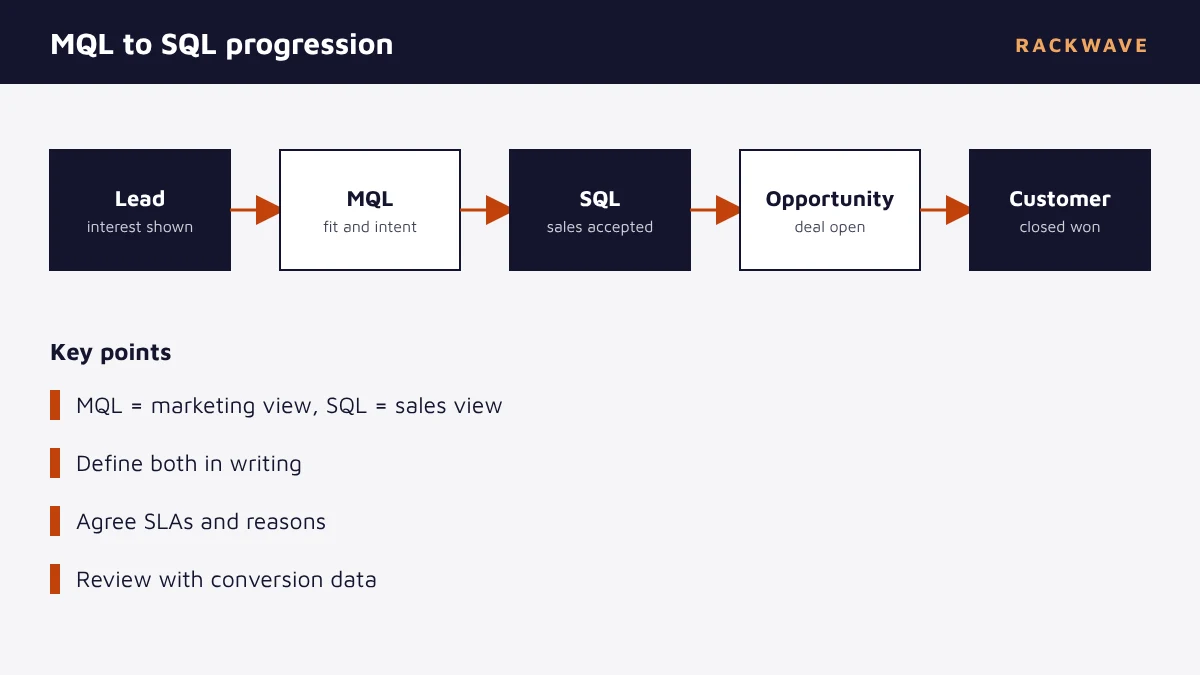
The lead lifecycle around MQL and SQL
| Stage | Definition | Owner |
|---|---|---|
| Subscriber or visitor | Known contact with limited interest | Marketing |
| Lead | Has shown some interest or provided details | Marketing. See lead generation |
| MQL | Meets marketing qualification criteria | Marketing to sales hand-off |
| SQL | Accepted by sales as a real opportunity | Sales. See lead management |
| Opportunity | In an active deal with a value and stage | Sales |
| Customer | Closed won | Sales, then success. See customer lifecycle management |
How to define MQL and SQL criteria
- Analyse your best customers. Review closed-won deals for the attributes and behaviours they had before buying.
- Define fit. Agree the ideal customer profile and persona. See buyer persona.
- Define engagement. Choose behaviours that signal interest, and weigh them: a demo request is stronger than a blog visit.
- Set the MQL threshold. Combine fit and engagement into a score or rule that triggers hand-off.
- Write the SQL criteria. Choose a qualification framework and define what the rep must confirm.
- Document the service levels. Set response times for sales and quality feedback for marketing.
- Build it in the CRM. Create lifecycle stages, scoring, routing and reports. See CRM software.
- Review quarterly. Compare conversion rates and adjust thresholds with evidence.
Setting up MQL and SQL in your CRM
The CRM is where definitions become operational. Lifecycle stage fields show where each lead is, scoring rules mark contacts as MQLs, and routing assigns them to the right owner with a task and a deadline. A required rejection reason when sales declines an MQL feeds back into marketing. Reports show conversion rates from lead to MQL to SQL to opportunity, time spent in each stage and results by source. Our CRM and lifecycle service builds this model on HubSpot, Salesforce and Dynamics 365, and our marketing automation guide explains the automation behind it.
Service level agreement between marketing and sales
| Commitment | Marketing | Sales |
|---|---|---|
| Volume and quality | Deliver agreed MQL volume at agreed quality | Work every MQL within the agreed time |
| Speed | Route MQLs instantly | Contact within hours, not days |
| Feedback | Act on rejection reasons | Record accept or reject with a reason |
| Nurture | Nurture rejected leads. See lead nurturing | Return leads that need more time to marketing |
MQL and SQL metrics
| Metric | What it shows |
|---|---|
| MQL to SQL conversion | Quality of marketing leads and sales follow-up |
| SQL to opportunity and opportunity to win | Quality of qualification and the sales process |
| Time from MQL to SQL | Speed and efficiency of the hand-off |
| Acceptance and rejection rates by source | Which channels produce credible leads |
| Pipeline and revenue by source | Real return. See sales funnel |
| Cost per MQL and per SQL | Efficiency. See customer acquisition cost |
Common MQL and SQL mistakes
- Using vague definitions that mean different things to each team.
- Counting MQLs as the main marketing goal instead of pipeline and revenue.
- Passing leads on a form fill alone, with no fit check.
- Leaving MQLs untouched for days.
- Letting sales reject leads without recording a reason.
- Never revisiting scoring even when conversion data changes.
Is the MQL model still right for you?
Some companies are moving away from MQLs, especially those with product-led growth or account-based strategies. In product-led models, a product qualified lead, based on usage in a free trial, may be a stronger signal than a content download. In account-based marketing, the focus is on engaged accounts rather than individual leads. See account-based marketing. The principle remains the same: agree what a good lead looks like, based on data, and make the hand-off explicit. The labels matter less than the shared definition.
A short example
A software company counts any lead with a score above 50 as an MQL, yet sales accepts fewer than a quarter of them. Joint analysis of closed-won deals shows that leads from companies with more than 50 employees and who visited the pricing page twice converted at several times the average rate. The teams rewrite the MQL rule to require both signals, add a demo request as an automatic fast-track, and agree that sales will contact MQLs within four hours and record a reason for any rejection. MQL volume falls, but acceptance rises to well over half, and pipeline from marketing grows. Marketing and sales now argue about how to improve results instead of whose numbers are right.
Key takeaways
- An MQL meets marketing criteria for fit and engagement; an SQL is accepted by sales as a real opportunity.
- Define both in writing using data from closed-won deals.
- Build lifecycle stages, scoring, routing and rejection reasons in the CRM.
- Agree service levels for speed and feedback between teams.
- Measure conversion, time between stages and revenue by source, and review thresholds quarterly.
Quick glossary
| Term | Meaning |
|---|---|
| MQL | Marketing qualified lead |
| SQL | Sales qualified lead |
| BANT | Budget, authority, need, timeline |
| Product qualified lead | A lead qualified by product usage |
| Service level agreement | A commitment between teams on speed and quality |
Read next: Voice of Customer: Sources, Programme and Examples · Omnichannel Marketing: Strategy, Examples and Technology · RFM Analysis: Scoring, Segments and Marketing Use
Frequently asked questions
What is the difference between MQL and SQL?
An MQL is a lead marketing considers likely to buy, based on fit and engagement. An SQL is a lead that sales has qualified as a real opportunity after confirming need, authority and timing.
What is an MQL?
A marketing qualified lead is a contact whose fit and engagement meet criteria set by marketing, indicating a higher likelihood of becoming a customer than an average lead.
What is an SQL?
A sales qualified lead is a lead that a sales representative has reviewed and accepted as a genuine opportunity, usually after confirming need, authority, budget and timeline.
How do you define MQL criteria?
Analyse closed-won deals, define the ideal customer profile and persona, choose weighted engagement behaviours and combine them into a score or rule that triggers hand-off.
What is BANT?
BANT is a qualification framework: budget, authority, need and timeline. Reps use it to confirm whether a lead is a real opportunity.
How should marketing and sales work together on MQLs?
Agree written definitions and service levels: marketing delivers leads at agreed quality, sales responds within an agreed time and records accept or reject reasons.
What is a good MQL to SQL conversion rate?
It varies by industry, lead source and definition. Track your own rate by source and aim to improve it by adjusting criteria and follow-up speed.
Is the MQL model still relevant?
It remains useful for many B2B teams, though product-led and account-based companies may use product qualified leads or account engagement. The key is a shared, data-based definition.