

What is DMARC? It is an email authentication policy that tells receiving servers what to do with messages that claim to come from your domain but fail authentication. It builds on SPF and DKIM, adds reporting, and is now a requirement for bulk senders at Gmail and Yahoo. This guide explains what DMARC is, how alignment works, what each policy does, how to read the reports and how to roll it out without blocking legitimate mail.
Short answer: DMARC (Domain-based Message Authentication, Reporting and Conformance) lets a domain owner publish a DNS record that says: check SPF and DKIM against the visible From domain, and if both fail, apply my policy (none, quarantine or reject) and send me reports. A minimal record is v=DMARC1; p=none; rua=mailto:dmarc@example.com.
What is DMARC?
DMARC is defined in RFC 7489 and promoted by the industry group at dmarc.org. It solves a gap left by its predecessors. SPF and DKIM each prove something about a message, but neither one is tied to the From address that recipients see. An attacker can pass SPF on a domain they own while showing your brand in the From line.
DMARC closes that gap with two ideas. First, alignment: the domain authenticated by SPF or DKIM must match the domain in the From header. Second, policy and reporting: the domain owner states what receivers should do when a message fails, and receives data showing who is sending mail in their name.
How DMARC works
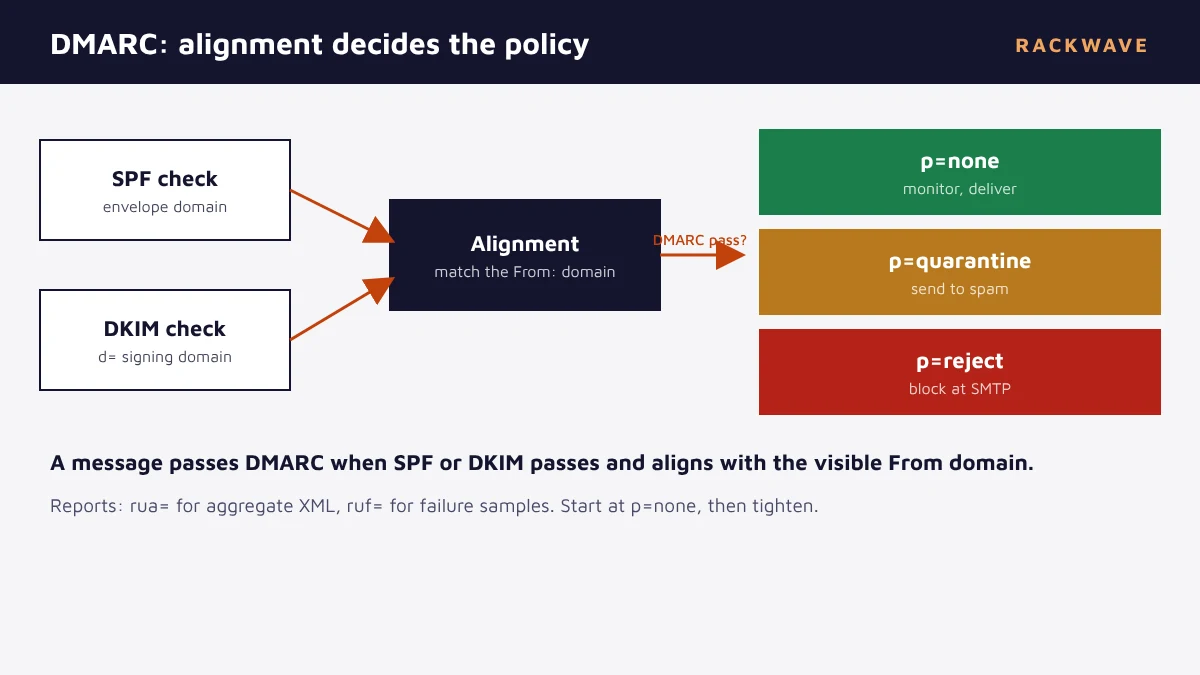
- A message arrives. The receiver reads the domain in the From header and looks up the DMARC record at _dmarc.yourdomain.com.
- SPF and DKIM are evaluated. The receiver runs the SPF check on the envelope sender and verifies any DKIM signature.
- Alignment is tested. At least one passing method must use a domain that matches the From domain. Relaxed alignment allows a subdomain match, and strict alignment requires an exact match.
- The policy is applied. If DMARC fails, the receiver follows your p= policy: deliver, quarantine to spam or reject.
- Reports are sent. Receivers send aggregate reports to the address in your rua tag, usually once a day.
DMARC record syntax
A DMARC record is a TXT record published at _dmarc.yourdomain.com. Tags are separated by semicolons.
_dmarc.example.com. IN TXT "v=DMARC1; p=none; rua=mailto:dmarc-reports@example.com; adkim=r; aspf=r"| Tag | Meaning | Common values |
|---|---|---|
| v | Version. Must be first | DMARC1 |
| p | Policy for the domain | none, quarantine, reject |
| sp | Policy for subdomains | none, quarantine, reject |
| rua | Where to send aggregate reports | mailto:address |
| ruf | Where to send failure samples (many receivers do not send these) | mailto:address |
| adkim / aspf | DKIM and SPF alignment mode | r (relaxed), s (strict) |
| pct | Percentage of mail the policy applies to | 1 to 100 |
DMARC policies: none, quarantine and reject
| Policy | What the receiver does with failures | When to use it |
|---|---|---|
| p=none | Delivers the mail as normal and reports the result | Start here to discover all your senders |
| p=quarantine | Treats failing mail as suspicious, usually spam folder | After reports show legitimate mail passes |
| p=reject | Refuses failing mail during SMTP delivery | Final target for full spoofing protection |
The aim is to reach reject, because only enforcement stops others from spoofing your domain. Reaching it safely takes time, as described in the rollout plan below.
Why DMARC matters now
Since 2024, Google and Yahoo have required senders of bulk mail to publish a DMARC record, alongside SPF, DKIM, one-click unsubscribe and low spam rates. Google's sender guidelines set out the details. Beyond compliance, DMARC delivers three practical benefits.
- Protection: it makes phishing that impersonates your domain much harder to deliver.
- Visibility: reports reveal forgotten systems that send mail as you, such as old CRMs or marketing tools.
- Deliverability: authenticated, aligned mail builds trust with mailbox providers over time.
You cannot protect a domain you cannot see. DMARC reports show you every system sending as you.
A safe DMARC rollout plan
Jumping straight to reject is the quickest way to block your own invoices, newsletters or support replies. Follow a staged path instead.
- Inventory your senders. List every service that sends mail with your domain: mailbox provider, marketing tool, billing system, support desk and servers.
- Fix SPF and DKIM first. Make sure each sender signs with DKIM using your domain and, where possible, uses an aligned return-path.
- Publish p=none with a rua address. Collect reports for two to four weeks.
- Read the reports and fix failures. Resolve each legitimate source that fails alignment. Block or ignore sources you do not recognise.
- Move to quarantine gradually. Use pct to apply the policy to a small share of mail, then raise it.
- Move to reject. Once failures are only illegitimate, set p=reject and keep monitoring.
How to read DMARC reports
Aggregate reports arrive as compressed XML files. Each lists the sending IP, the volume of messages, the SPF and DKIM results and the disposition applied. Reading raw XML at scale is impractical, so most teams use a DMARC reporting tool or a managed service that parses reports into a dashboard.
Look for three patterns. Known senders failing alignment need configuration fixes. Unknown senders with high volume may be shadow IT or abuse. Forwarded mail failing SPF is normal and is usually rescued by DKIM, which is another reason to sign everything.
Common DMARC mistakes
- Publishing reject too early and blocking legitimate mail from tools that were never aligned.
- Forgetting subdomains. Attackers can use subdomains, so set sp= or publish records for them.
- Using a mailbox that cannot cope with reports. Send rua to a dedicated address or reporting service.
- Ignoring third-party senders. Every platform that sends as you must sign with your domain or align its return-path.
- Treating DMARC as one-off. New tools get added, so review reports monthly.
Authentication also sits underneath everything else in email delivery. The same discipline applies when you choose an SMTP server or plan a warm-up for a new IP.
DMARC for third-party senders
Most DMARC projects stall on third-party platforms. Your CRM, support desk, billing system and marketing tool may each send mail using your domain, and each one needs to pass SPF or DKIM in alignment. The reliable way is to ask every vendor for domain authentication: they give you CNAME or TXT records that let them sign with a DKIM key under your domain, and often a custom return-path so SPF aligns too.
Do this before you tighten policy. A sender that signs with the vendor's own domain will pass DKIM but fail alignment, so DMARC will treat the mail as failing as soon as you enforce. Reports at p=none are how you find these cases while the cost of an error is still zero.
Subdomains, BIMI and what comes next
DMARC policy cascades to subdomains unless you override it with sp=. Many organisations enforce reject on the main domain, then use a separate subdomain for marketing with its own policy so experiments cannot endanger corporate mail.
Enforcement also unlocks extras. Brand Indicators for Message Identification (BIMI) lets supporting mailbox providers show your logo beside authenticated messages, and it requires a DMARC policy of quarantine or reject. Treat it as a reward for finishing the work rather than a reason to rush it.
How DMARC fits with the rest of your email stack
DMARC does not replace content filtering or reputation management. It answers one question: is this message really from the domain it claims? Receivers combine that answer with engagement, complaint rates and content signals. A fully aligned domain that sends unwanted mail will still struggle, so pair DMARC with list quality and a sensible bounce handling process.
Keep a rollback plan. Record your previous policy and DNS TTL before every change. If legitimate mail is blocked after tightening the policy, you can revert quickly and investigate with data.
Want DMARC enforced without the risk?
We inventory your senders, fix alignment and move you from monitoring to reject with a tested plan.
Read next: Email Bounce: Hard vs Soft Bounces, Codes and Fixes · Email Warm Up: How to Warm a New IP or Domain Safely · SPF Record: Syntax, Examples and How to Fix Common Errors
Frequently asked questions
What is DMARC in simple terms?
DMARC is a DNS-based policy that tells receiving mail servers how to handle messages that claim to come from your domain but fail SPF and DKIM checks, and asks them to send you reports about those messages.
What does DMARC stand for?
DMARC stands for Domain-based Message Authentication, Reporting and Conformance.
Is DMARC required?
Google and Yahoo require a DMARC record from bulk senders, and many large organisations and regulators expect it. Even where it is not mandatory, it is the main defence against domain spoofing.
What is the difference between SPF, DKIM and DMARC?
SPF lists which servers may send for a domain. DKIM signs messages so changes can be detected. DMARC ties both to the visible From domain, sets a policy for failures and provides reporting.
What DMARC policy should I use?
Start with p=none to collect reports, move to quarantine once legitimate mail passes, and finish at reject. Staged enforcement avoids blocking valid email.
What is DMARC alignment?
Alignment means the domain verified by SPF or DKIM matches the domain in the From header. Relaxed alignment allows subdomains of the same organisational domain, while strict alignment needs an exact match.
How do I add a DMARC record?
Publish a TXT record at _dmarc.yourdomain.com with a value such as v=DMARC1; p=none; rua=mailto:reports@yourdomain.com. Then monitor the reports before tightening the policy.
How long does it take to reach DMARC enforcement?
Many organisations take one to three months, depending on how many third-party senders they must align. Larger or older estates can take longer.