
Master data management is the discipline of creating and maintaining one trusted, consistent version of the core data a business depends on, such as customers, products, suppliers and locations, and sharing it with every system that needs it. When the same customer appears three times with three spellings across CRM, billing and support, reports disagree and processes fail. Master data management, often shortened to MDM, fixes the source of that disagreement. This guide explains what MDM is, how it works, the main architecture styles, benefits, challenges and how to start.
Short answer: MDM builds a "golden record" for each key business entity by matching, merging and governing data from many systems, then distributes that record back to the systems that use it.
What is master data management?
Master data management is a combination of processes, governance and technology that keeps an organisation's critical, shared data accurate and consistent. Master data is the slow-changing information that describes the things a business deals with: customers, products, employees, suppliers, accounts, assets and locations. It is different from transactional data, such as an individual order, which records events and changes constantly.
Most organisations hold master data in many places. A customer might exist in the CRM, the ERP, the e-commerce platform and the support desk, each with slightly different details. MDM reconciles these into one authoritative record and keeps it that way.
Master data vs transactional data vs reference data
| Type | What it is | Examples | Change rate |
|---|---|---|---|
| Master data | Core entities the business describes | Customer, product, supplier | Low to medium |
| Transactional data | Events and activities | Orders, invoices, payments | High |
| Reference data | Shared lookup values | Country codes, currencies, units | Very low |
How master data management works
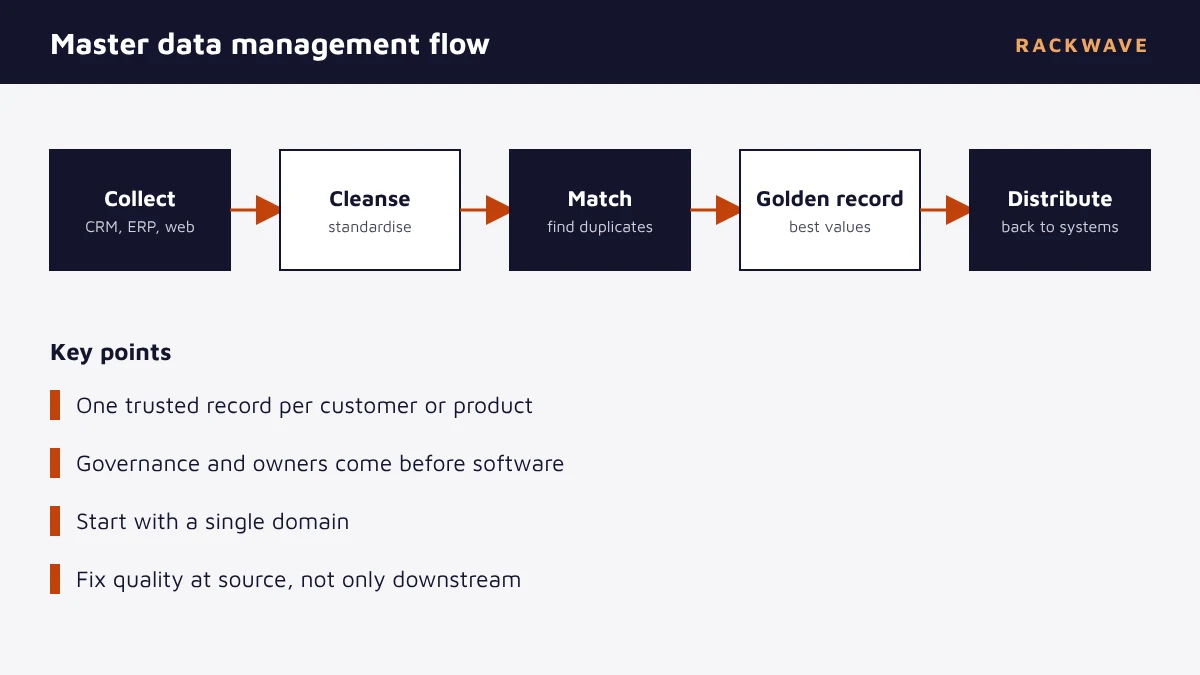
- Collect. Extract master data from CRM, ERP, e-commerce, support and other sources.
- Standardise and cleanse. Correct formats, fix obvious errors and apply consistent rules to names, addresses and codes.
- Match. Use exact and fuzzy matching to find records that describe the same real-world entity.
- Merge and survive. Combine matches into one golden record, choosing the best value for each field by rules, such as "most recent" or "most trusted source".
- Govern. Define owners, approval workflows and quality rules so the record stays correct.
- Distribute. Publish the golden record to consuming systems through APIs, events or batch feeds.
What is a golden record?
A golden record is the single, best version of an entity, assembled from every source. Suppose a customer is stored as "Jon Smith, 12 Park Rd" in the CRM, "Jonathan Smith, 12 Park Road" in billing and has a newer phone number in support. The golden record keeps the full legal name, the standard address and the latest phone number, and links back to every source record so changes can be traced.
A golden record is not the biggest record. It is the most trusted one, with the reasons visible.
MDM architecture styles
| Style | How it works | Strength | Trade-off |
|---|---|---|---|
| Registry | Stores only an index linking matching records; data stays in sources | Low disruption, quick to start | Limited ability to correct data at source |
| Consolidation | Copies data into a hub for matching and reporting | Good for analytics and reporting | Hub is read-only; sources are not updated |
| Coexistence | Hub holds the golden record and syncs changes both ways | Balanced; improves source quality | More complex synchronisation |
| Centralised (transactional) | Hub is the only place master data is created and edited | Strongest consistency | Biggest process change |
Most programmes start with registry or consolidation to prove value, then move to coexistence as governance matures. Centralised MDM is powerful but usually needs the organisation to change how it creates data, not just which software it uses.
Benefits of master data management
- Better decisions: reports built on one definition of "customer" or "product".
- Better customer experience: every team sees the same profile, so customers do not repeat themselves.
- Lower operating cost: less manual cleaning and fewer failed deliveries or invoices.
- Compliance: easier to find and manage personal data when it lives in a governed record.
- Stronger analytics and AI: models trained on clean, consistent entities perform better.
Common MDM domains
- Customer MDM: unifies individuals and organisations, households and hierarchies across sales, service and marketing.
- Product MDM: keeps product attributes, categories and identifiers consistent across catalogue, ERP and sales channels.
- Supplier MDM: manages vendor details, risk and contracts.
- Location and asset MDM: keeps sites, equipment and hierarchies consistent for operations.
Many organisations start with one domain, usually customer or product, because that is where inconsistency hurts most.
MDM, data governance, data warehouse and CDP: how they differ
| Concept | Purpose | Link to MDM |
|---|---|---|
| Data governance | Policies, ownership and standards for data | Governance sets the rules MDM enforces. See what is data governance |
| Data warehouse | Stores history for analysis | Consumes MDM data for consistent reporting. See what is a data warehouse |
| Customer data platform | Unifies customer behaviour and profile data for marketing | Overlaps with customer MDM, but focuses on activation. See Salesforce Data Cloud |
| CRM | Manages relationships and sales or service work | A major source and consumer of customer master data. See what is CRM |
Challenges of MDM
- Ownership. Nobody owns "the customer", so nobody agrees on the rules. Appoint data owners and stewards before buying software.
- Matching accuracy. Too loose and unrelated people merge; too strict and duplicates remain. Tune with samples and keep humans in the loop for borderline cases.
- Source system resistance. Teams fear losing control of data they create. Show them how the result helps them.
- Scope creep. Trying to master every entity at once stalls programmes. Begin with one domain.
- Ongoing effort. MDM is a service that runs continuously, not a one-off clean-up.
How to start an MDM programme
- Pick one domain and one business problem. For example, duplicate customers causing billing errors.
- Assess current data. Profile quality, volumes and where each attribute is created.
- Define governance. Name owners and stewards, set quality rules and an approval process for changes.
- Choose the architecture style. Start with the lightest style that solves the problem.
- Build matching and survivorship rules. Test on real samples and document every rule.
- Integrate with source systems. Use APIs and events to publish and receive updates. Our system integration service covers this layer.
- Measure. Track duplicate rate, completeness and the business outcome you chose at the start.
Practical tip: Fixing data at the source beats cleaning it downstream. If the CRM lets users create duplicates, add validation and duplicate rules there too. Salesforce users can start with duplicate rules.
MDM and data migration
MDM and migration are closely related. Moving to a new CRM or ERP is the cheapest moment to deduplicate and standardise master data, because the data is already being extracted and mapped. Our guide to what is data migration explains the lifecycle. Skipping this step usually means carrying old duplicates into the new system.
Choosing MDM software
Compare tools on the domains they cover, matching quality, workflow and stewardship interfaces, integration options, scalability, security and total cost. Ask vendors to match a messy sample of your own data in a proof of concept, not a demo dataset. For data strategy, quality programmes and platform selection, see our data governance service and data warehousing service.
Key takeaways
- MDM creates one trusted record for each key entity such as customer or product.
- Matching, survivorship and governance create the golden record.
- Start with one domain and the lightest architecture that solves the problem.
- Ownership and stewardship matter more than the software.
- Fix quality at source and integrate the golden record back into every system.
Quick glossary
| Term | Meaning |
|---|---|
| Golden record | The single best version of an entity |
| Survivorship | Rules deciding which source value wins |
| Data steward | Person responsible for the quality of a data domain |
| Fuzzy matching | Matching that tolerates spelling and format differences |
| Hierarchy | Relationships such as parent company and subsidiaries |
Read next: Lead Nurturing: Strategy, Tactics and Examples · Data Quality: Dimensions, Causes and How to Improve It · What Is a Data Pipeline? Components, Types and Examples
Frequently asked questions
What is master data management in simple terms?
Master data management is the practice of keeping one accurate, consistent version of the core data a business relies on, such as customers and products, and sharing it across all systems.
What is master data?
Master data is the slow-changing core information that describes business entities such as customers, products, suppliers, employees and locations. It differs from transactional data, which records events like orders and payments.
What is a golden record in MDM?
A golden record is the single, most trusted version of an entity, built by matching and merging records from several systems and choosing the best value for each field.
What are the types of MDM architecture?
The main styles are registry, consolidation, coexistence and centralised. They differ in whether the hub only indexes data, stores copies, syncs both ways or becomes the place where data is created.
What is the difference between MDM and data governance?
Data governance defines policies, ownership and standards. MDM is the process and technology that applies those standards to specific shared data and keeps it consistent across systems.
Why do companies need MDM?
Without it, the same customer or product appears differently in each system, causing reporting errors, duplicate work, poor customer experience and compliance risk.
How long does an MDM project take?
A focused first domain can show results in a few months. A full programme across several domains is a longer, ongoing effort tied to governance and system changes.
Is MDM the same as a CRM?
No. A CRM manages customer relationships and sales or service processes. MDM keeps the underlying customer data consistent across the CRM and every other system.