
A customer data platform, or CDP, is software that collects customer data from many sources, such as websites, apps, CRM, e-commerce and support, unifies it into persistent individual profiles and makes those profiles available to other systems for analytics, segmentation and personalised engagement. It solves a common problem: customer information scattered across tools, with no single view of who the customer is or what they have done. This guide explains what a customer data platform is, what it does, how it differs from a CRM, a data warehouse and a data management platform, its core capabilities, how to decide whether you need one, how to implement it step by step, the privacy and governance it requires and the mistakes that turn a CDP into another silo.
Short answer: A CDP ingests data from many sources, resolves identities into unified customer profiles, builds segments and activates them in marketing, sales and service tools. You need one when customer data is fragmented and real-time personalisation matters. Start with clear use cases, not with the technology.
What is a customer data platform?
The CDP category emerged to give marketers and data teams a managed, reusable customer profile. Industry bodies define it as packaged software that creates a persistent, unified customer database accessible to other systems, a description reflected in the customer data platform article. It is a key building block for single customer view, marketing personalization and omnichannel marketing.
What a CDP does
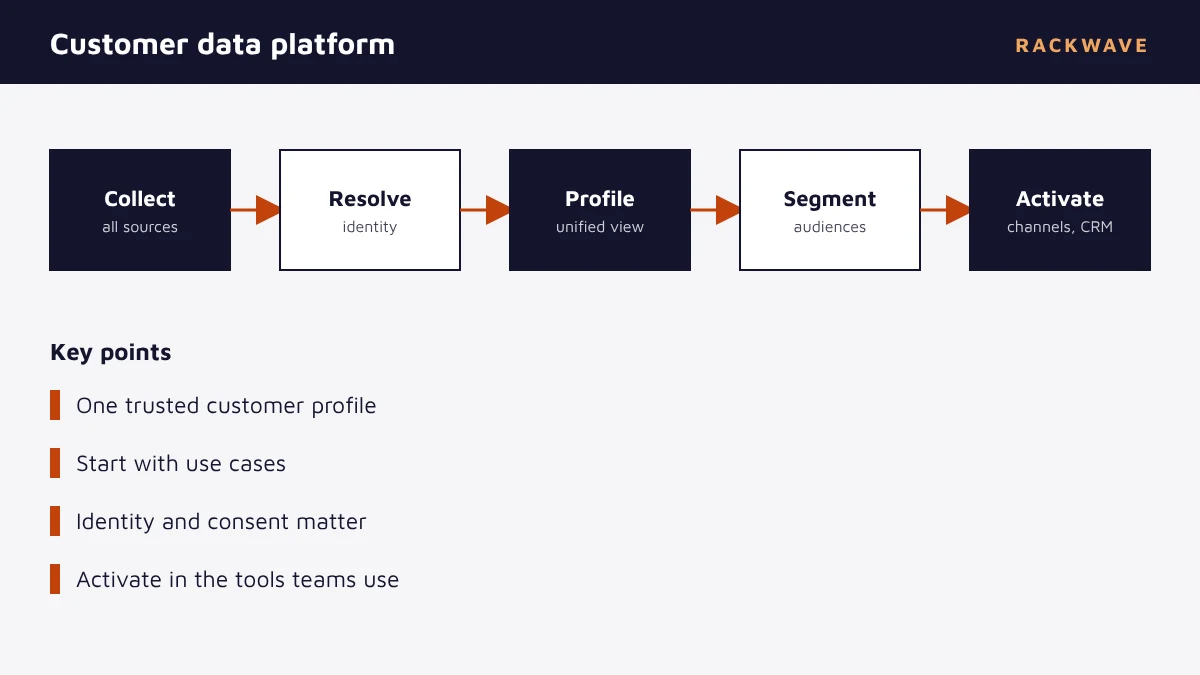
| Capability | Description |
|---|---|
| Data collection | Ingests events and records from web, mobile, CRM, commerce, support and offline sources |
| Identity resolution | Matches identifiers such as email, device and customer ID into one profile |
| Unified profile | Stores attributes, events, consent and history for each customer |
| Segmentation | Builds audiences from attributes and behaviour. See customer segmentation |
| Activation | Sends audiences and data to email, advertising, engagement and CRM tools |
| Consent and governance | Tracks preferences and applies privacy rules |
| Analytics and AI | Supports scoring, predictions and insight. See customer analytics |
A CDP is not a place to store data. It is a way to make the same, trusted customer view available wherever decisions are made.
CDP vs CRM vs data warehouse vs DMP
| System | Main purpose | Data type | Typical user |
|---|---|---|---|
| CDP | Unify and activate customer profiles | First-party behavioural and transactional data | Marketing and data teams |
| CRM | Manage relationships and processes. See CRM software | Accounts, contacts, deals, cases | Sales, service, success |
| Data warehouse | Store and analyse large structured datasets. See data warehousing service | Any structured business data | Analysts and engineers |
| DMP | Target anonymous audiences for advertising | Third-party and anonymous data | Advertisers |
These systems overlap, and modern stacks often combine them. Some companies build CDP capabilities on top of a warehouse, an approach sometimes called a composable CDP, using reverse ETL to send audiences to activation tools. Others buy a packaged platform. The right choice depends on your data maturity, team skills and need for real-time activation.
Do you need a CDP?
| Sign | Meaning |
|---|---|
| Customer data is spread across many tools | You lack a single customer view |
| Personalisation relies on slow or manual exports | You need faster activation |
| Different teams report different customer counts | You need agreed identity and definitions |
| Consent and preferences are inconsistent | You need central privacy control |
| Campaigns cannot use behaviour from other channels | You need cross-channel data |
If your data is small and sits mainly in one CRM, a CDP may be more than you need. If you have several channels, large volumes and ambitions for real-time personalisation, it can be transformative. Our CDP consulting helps you decide.
How to implement a customer data platform
- Define use cases. Choose a few high-value uses, such as abandoned-basket recovery, churn prevention or loyalty personalisation.
- Audit data sources. List the systems, identifiers and quality of each. See data quality.
- Design the profile and identity rules. Decide which attributes, events and match keys define a customer.
- Select the approach. Choose between a packaged CDP, a warehouse-centred composable approach or an engagement platform with CDP features.
- Integrate sources. Connect web, app, CRM, commerce and support data. See CRM integration.
- Set consent and governance. Capture preferences and enforce rules by region and channel. See data governance.
- Activate. Send audiences to engagement platforms and CRM. See lifecycle marketing.
- Measure and expand. Prove value on the first use cases, then add more.
CDP and engagement platforms
CDPs feed the tools that talk to customers. We connect CDPs and warehouses with Braze, CleverTap, Klaviyo, Iterable, Salesforce Marketing Cloud and Oracle Responsys, and to your CRM through our CRM and lifecycle service and system integration service.
Privacy and governance
- Record consent and purpose for every data use, and honour withdrawal quickly.
- Apply regional rules such as data residency and retention limits.
- Limit access by role and log data use.
- Minimise the data you store to what you can justify.
- Document data lineage so you can explain where each attribute came from.
CDP metrics
| Metric | What it shows |
|---|---|
| Identity match rate | How well profiles are unified |
| Profile completeness | Quality of the unified record |
| Time to activate an audience | Operational speed |
| Campaign uplift against holdout | Business value |
| Consent coverage | Compliance readiness |
| Data freshness | Timeliness of profiles |
Common CDP mistakes
- Buying a CDP before defining use cases.
- Loading all data without a plan for quality or governance.
- Ignoring identity resolution rules, creating false merges or duplicates.
- Failing to connect the CDP to the tools that act on the data.
- Treating it as an IT project with no business owner.
- Overlooking consent and privacy.
A short example
A retailer has separate customer lists for its website, mobile app, stores and support desk. The same person appears as four customers, and campaigns repeatedly offer discounts to people who already bought. It implements a CDP with email and loyalty ID as the main match keys, brings in transactions, web and app events and support tickets and builds three audiences: recent purchasers to suppress from acquisition offers, lapsing loyal customers and high-value customers browsing without buying. Activation into email and mobile channels leads to fewer wasted offers and a measurable lift in repeat purchase. The technology helped, but the real gain came from deciding which customer questions to answer first.
Identity resolution in practice
Identity resolution is the hardest and most valuable part of a CDP. Deterministic matching links records that share an exact identifier, such as a verified email address or customer ID, and it is safe and explainable. Probabilistic matching infers links from patterns such as device and behaviour, which widens coverage but adds risk of false merges. Most business uses should rely on deterministic keys first, add probabilistic methods only where the value justifies the risk and keep a clear audit trail so a wrong merge can be undone. Decide early how anonymous activity will be attached to a known profile once the person logs in or makes a purchase, and how you will handle shared devices and household accounts.
| Matching method | Strength | Risk |
|---|---|---|
| Deterministic | Accurate, explainable | Lower coverage |
| Probabilistic | Wider coverage | False merges, harder to explain |
| Hybrid | Balances both | Needs careful rules and monitoring |
Key takeaways
- A CDP unifies customer data from many sources into persistent profiles and activates it in other tools.
- It differs from a CRM, a warehouse and a DMP, though stacks often combine them.
- Start with clear use cases and check whether a CDP, a composable approach or an engagement platform fits.
- Build identity rules, consent and governance into the design.
- Measure match rate, activation speed and uplift against holdouts.
Quick glossary
| Term | Meaning |
|---|---|
| CDP | Customer data platform |
| Identity resolution | Matching identifiers to one customer profile |
| First-party data | Data collected directly from your own customers |
| Composable CDP | CDP capabilities built on a data warehouse |
| Reverse ETL | Sending warehouse data back to operational tools |
Read next: Voice of Customer: Sources, Programme and Examples · Omnichannel Marketing: Strategy, Examples and Technology · RFM Analysis: Scoring, Segments and Marketing Use
Frequently asked questions
What is a customer data platform?
A CDP collects customer data from many sources, unifies it into persistent individual profiles and makes it available to other systems for analytics, segmentation and personalised engagement.
What is the difference between a CDP and a CRM?
A CRM manages relationships and processes such as deals and cases. A CDP unifies behavioural and transactional data into profiles and activates audiences across channels.
What is the difference between a CDP and a data warehouse?
A warehouse stores and analyses large datasets for reporting. A CDP focuses on unified customer profiles and activating them in marketing and service tools, often in near real time.
Do I need a customer data platform?
You may if customer data is fragmented across tools, personalisation relies on manual exports or teams cannot agree on customer counts. Small, single-system businesses may not.
What is identity resolution?
Identity resolution matches identifiers such as email, phone, device and customer ID to build one profile per person across channels.
What is a composable CDP?
A composable CDP builds CDP capabilities, such as identity, segmentation and activation, on top of a data warehouse using modular tools, rather than buying one packaged platform.
How do I implement a CDP?
Define use cases, audit data sources, design profiles and identity rules, choose an approach, integrate sources, set consent and governance, activate and measure.
Is a CDP compliant with privacy laws?
A CDP can support compliance by tracking consent and applying rules, but compliance depends on how you configure it and how you collect and use data.