
Customer analytics is the practice of collecting and analysing data about customers, including who they are, what they buy, how they behave and why they leave, to make better decisions about marketing, sales, service and product. It turns the records held in a CRM, e-commerce platform and other systems into answers: who are our best customers, who is likely to churn, which offers work, and what do customers look like at each stage of the journey. This guide explains what customer analytics is, the main types of analysis, the key metrics, the data and tools needed, how to build a programme step by step, how to use CRM data effectively and the mistakes that produce impressive dashboards and no decisions.
Short answer: Customer analytics combines descriptive, diagnostic, predictive and prescriptive analysis of customer data. Start with a clear business question, such as why customers leave, unify the data you need, analyse by segment and cohort, and connect the findings to actions in your CRM and engagement tools.
What is customer analytics?
Customer analytics sits where data analysis meets customer strategy. It draws on data analysis techniques and applies them to the customer relationship. Its purpose is not reporting for its own sake but better decisions: whom to target, what to offer, how to serve and when to intervene. It builds on the records in your CRM and supports customer retention, customer segmentation and customer lifetime value.
Types of customer analytics
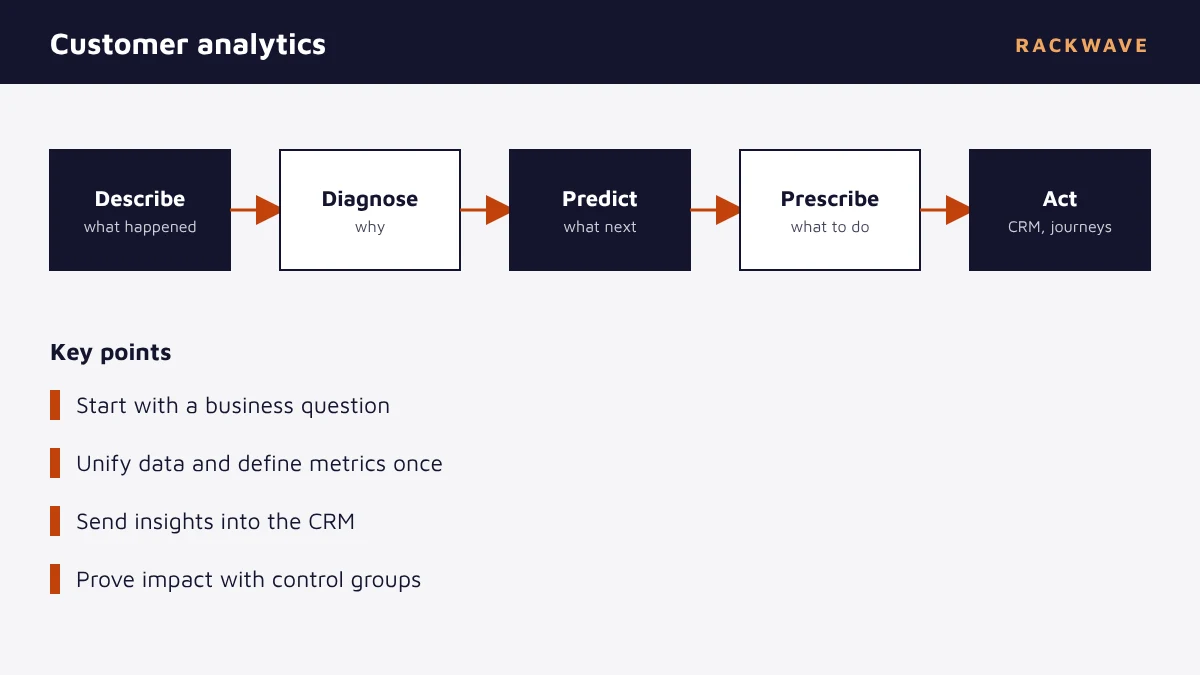
| Type | Question | Example |
|---|---|---|
| Descriptive | What happened? | Sales by segment, active customers, churn rate |
| Diagnostic | Why did it happen? | Why churn rose among a particular cohort. See cohort analysis |
| Predictive | What is likely to happen? | Churn risk, next purchase, lifetime value. See predictive analytics |
| Prescriptive | What should we do? | Next best offer, which customers to call first |
Analytics is valuable only when it changes what someone does on Monday morning.
Key customer analytics techniques
| Technique | What it does |
|---|---|
| Segmentation | Groups customers by shared attributes or behaviour |
| RFM analysis | Ranks customers by recency, frequency and monetary value. See RFM analysis |
| Cohort analysis | Follows groups of customers over time |
| Churn prediction | Scores customers by likelihood to leave. See churn rate |
| Lifetime value modelling | Estimates future value of each customer |
| Propensity modelling | Predicts likelihood to buy, upgrade or respond. See upselling |
| Journey analysis | Studies paths and drop-off points. See customer journey mapping |
| Sentiment and text analysis | Extracts themes from feedback. See customer feedback |
Customer analytics metrics
| Metric | What it shows |
|---|---|
| Customer acquisition cost | Cost of winning customers. See customer acquisition cost |
| Customer lifetime value | Long-term worth of customers |
| Retention, churn and repeat rate | Loyalty and loss |
| Average order value and purchase frequency | Buying behaviour |
| Customer satisfaction and NPS | Sentiment. See net promoter score |
| Engagement and adoption | Depth of use. See customer engagement |
| Revenue and margin by segment | Where profit comes from |
Data sources for customer analytics
- CRM: accounts, contacts, deals, cases and activity.
- Transactions: orders, invoices and payments from e-commerce, ERP or billing.
- Behavioural: website, app and product events.
- Marketing: campaign responses, preferences and consent.
- Service: tickets, chat transcripts and satisfaction scores. See help desk.
- Third-party: firmographic and demographic enrichment, used carefully.
How to build a customer analytics programme
- Start with business questions. Choose a few decisions you want to improve, such as retention or campaign targeting.
- Audit and unify the data. Identify sources, match customers across systems and fix quality issues. See single customer view.
- Build the foundation. Use a warehouse or customer data platform to store clean, joined data. See customer data platform.
- Define metrics once. Agree definitions for customer, active, churn and revenue so everyone reports the same numbers.
- Start with descriptive and diagnostic analysis. Understand what is happening and why before predicting.
- Add predictive models. Build churn, propensity and value models where data supports them.
- Connect to action. Send segments and scores back to the CRM and engagement tools so teams can act.
- Measure impact and iterate. Test interventions against control groups and refine.
Tools and architecture
A typical stack has source systems, an integration layer, a warehouse or lakehouse, a modelling and BI layer, and tools that deliver results back to operations. Our data analytics service, data warehousing service, CDP consulting and AI and machine learning service design and build this, and our CRM and lifecycle service ensures insights flow into daily work on Salesforce, HubSpot and Dynamics 365. See also what is data analytics.
Using customer analytics in practice
| Goal | Analysis | Action |
|---|---|---|
| Reduce churn | Churn risk model and cohort analysis | Trigger save plays for high-risk accounts |
| Improve targeting | Segmentation and propensity models | Tailor campaigns and offers |
| Grow revenue per customer | Whitespace and next-best-offer analysis. See cross-selling | Recommend relevant products |
| Improve acquisition efficiency | CAC and LTV by channel | Shift budget to the best channels |
| Improve service | Ticket theme and sentiment analysis | Fix root causes and train teams |
Privacy, ethics and governance
Customer analytics deals with personal data, so it must respect consent, purpose limitation and security. Collect only the data you need, record the legal basis for using it, protect it with access controls and be transparent with customers. Be careful with models that could produce unfair outcomes, and review them for bias. Good governance builds the trust that allows analytics to continue. Our data governance service helps establish these controls.
Common customer analytics mistakes
- Starting with tools instead of questions.
- Building models on poor or fragmented data.
- Reporting averages that hide important segments.
- Producing insights nobody acts on.
- Not agreeing metric definitions, so teams quote different numbers.
- Overlooking privacy and consent.
A short example
A subscription business reports stable churn of 3 percent a month. Cohort analysis shows that customers acquired through one promotion churn at nearly twice the rate of others, and that early product usage is a strong predictor of retention. The team builds a simple risk score from first-month usage, sends high-risk customers a guided onboarding sequence and shifts budget away from the weak promotion. Compared with a control group, treated customers stay longer, and blended churn falls. The work used standard techniques. Its value came from connecting analysis to a specific action in the customer lifecycle.
Making analytics understandable to the business
Analysis that nobody understands changes nothing. Present findings as short stories: the question, the finding, the evidence and the recommended action. Prefer a few clear charts over crowded dashboards, show comparisons against a baseline and explain the limits of any model in plain language. Involve the people who will act on the result early, because they know which recommendations are practical. A weekly or monthly review where analysts and operators look at the same numbers builds trust and turns analytics from a report into a habit. Where possible, embed the output, such as a churn score or segment, directly in the CRM record so it is seen where decisions are made.
- State the business question in one sentence.
- Show the key finding with one or two clear visuals.
- Explain the evidence and its limits briefly.
- Recommend a specific action and an owner.
- Agree how the result will be measured.
Key takeaways
- Customer analytics turns customer data into decisions about marketing, sales, service and product.
- The four types are descriptive, diagnostic, predictive and prescriptive.
- Start with business questions, unify the data and define metrics once.
- Send insights back into the CRM and engagement tools so teams act.
- Respect privacy, consent and fairness, and test impact with control groups.
Quick glossary
| Term | Meaning |
|---|---|
| Descriptive analytics | Summarises what happened |
| Predictive analytics | Estimates what is likely to happen |
| Propensity | Likelihood that a customer will take an action |
| Cohort | A group of customers sharing a start period |
| Control group | A group left untreated to measure impact |
Read next: Voice of Customer: Sources, Programme and Examples · Omnichannel Marketing: Strategy, Examples and Technology · RFM Analysis: Scoring, Segments and Marketing Use
Frequently asked questions
What is customer analytics?
Customer analytics is the practice of analysing data about customers, including behaviour, purchases and feedback, to make better decisions in marketing, sales, service and product.
What are the types of customer analytics?
Descriptive analytics shows what happened, diagnostic explains why, predictive estimates what will happen and prescriptive recommends what to do.
What data is used for customer analytics?
CRM records, transactions, behavioural events, marketing responses, service interactions and feedback, sometimes enriched with third-party data.
What are key customer analytics metrics?
Customer acquisition cost, lifetime value, retention and churn, repeat purchase, average order value, satisfaction and NPS, engagement and revenue by segment.
How do I start with customer analytics?
Begin with a business question, audit and unify the data, define metrics, start with descriptive and diagnostic analysis, then add predictive models and connect results to action.
What tools are needed for customer analytics?
A CRM and source systems, an integration layer, a warehouse or customer data platform, modelling and BI tools and ways to send results back to operations.
How is customer analytics different from CRM?
A CRM records and manages customer interactions. Customer analytics analyses that and other data to find patterns, predict behaviour and guide decisions.
Is customer analytics compliant with privacy rules?
It can be, if you collect only needed data, have a lawful basis and consent where required, secure the data, are transparent and review models for fairness.