
A sales process is the repeatable set of steps a sales team follows to move a prospect from first contact to a closed deal, written down so that every rep knows what to do at each stage and managers know how to coach. A clear sales process makes results less dependent on individual stars, shortens ramp-up for new hires, improves forecasts and shows exactly where deals are lost. This guide explains the typical steps of a sales process, how to design one, the difference between a process and a methodology, how to support it with a CRM and playbooks, which metrics prove it is working and the mistakes that turn a process into paperwork.
Short answer: A sales process has defined stages, such as prospecting, qualification, discovery, proposal, negotiation and close, each with clear activities and exit criteria. Document it, build it into your CRM, coach to it and measure stage conversion so that you can improve it with evidence.
What is a sales process?
The sales process describes what the team does. The sales pipeline shows where each deal is within it, and the sales funnel shows how many people convert between steps. When all three are aligned, a manager can open the CRM and know what each deal needs without asking the rep. The idea of formalising selling steps is discussed in general terms in the personal selling article on Wikipedia.
The steps in a typical sales process
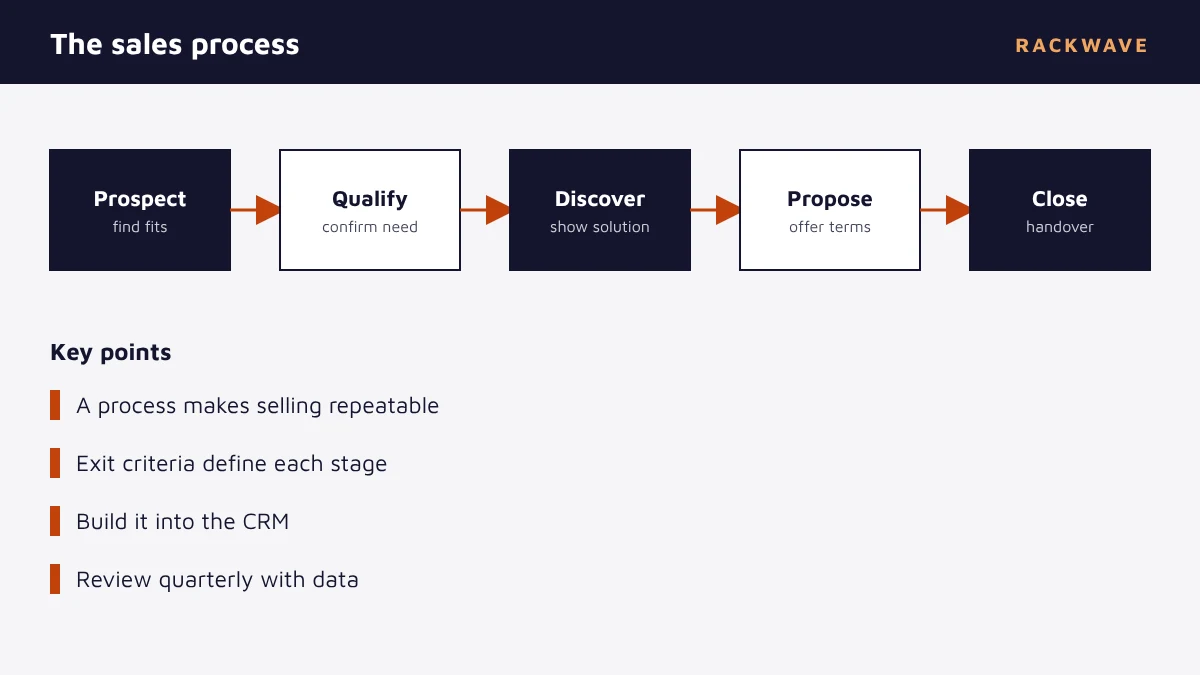
| Step | Goal | Key activities |
|---|---|---|
| 1. Prospecting | Find people who may need you | Research, outbound outreach, inbound lead review |
| 2. Connecting | Secure a first conversation | Personalised outreach, referrals, event follow-up |
| 3. Qualifying | Confirm fit and real intent | Need, budget, authority, timeline. See lead management |
| 4. Discovery and demo | Understand the problem and show how you solve it | Structured questions, tailored demonstration |
| 5. Proposal | Present a clear offer | Quote, business case, references |
| 6. Negotiation and close | Agree terms and sign | Handle objections, involve legal and procurement |
| 7. Handover and growth | Deliver value and expand | Onboarding, success plan, renewal. See customer onboarding |
Sales process vs sales methodology
A process is the map of stages. A methodology is the philosophy for how to conduct the conversations inside them. Well-known frameworks include SPIN, Challenger, MEDDIC and Solution Selling. You can adopt one without changing your stages, and many teams blend them. The important thing is that everyone uses the same language so that deal reviews are efficient.
| Framework | Core idea | Best suited to |
|---|---|---|
| SPIN | Ask situation, problem, implication and need-payoff questions | Complex consultative sales |
| Challenger | Teach buyers something new and take control of the conversation | Markets where buyers are well informed |
| MEDDIC | Qualify on metrics, economic buyer, decision criteria, process, pain and champion | Enterprise deals with several stakeholders |
| Solution Selling | Diagnose pain and align a solution | Mid-market B2B |
Process makes a good team repeatable. Coaching makes it improve.
How to design your sales process
- Study your best deals. Review recent wins and losses. Note the steps winners shared and where losses stalled.
- Draft the stages. Use the buyer's journey as a guide. Five to seven stages is usually enough.
- Define exit criteria. Write the evidence needed to advance, for example a confirmed budget owner for qualification.
- List the activities and assets. For each stage, decide the actions, emails, call guides and documents reps will use.
- Assign roles. Clarify who prospects, who runs demos, who owns pricing and who hands off to customer success.
- Build it into the CRM. Configure stages, required fields, validation and automation. See CRM software.
- Train and coach. Role-play each stage and review real deals against the criteria.
- Measure and revise. Review stage conversion quarterly and adjust.
Supporting the process with a CRM
A process that lives only in a slide deck is quickly forgotten. A CRM makes it operational: stage fields guide reps, validation rules stop deals advancing without evidence, and automation creates tasks and approvals. Dashboards then show managers conversion, cycle time and stuck deals. Our CRM implementation service translates your documented process into configuration on Salesforce, HubSpot or Dynamics 365, and our guide to sales automation explains what to automate first.
- Stage guidance: show tips and required actions on each stage screen.
- Validation: block a move to proposal until a decision maker is recorded.
- Tasks: create follow-up tasks automatically when a stage changes.
- Approvals: route discounts above a threshold to the right manager.
- Dashboards: conversion, cycle time and deal age by stage and rep.
Sales playbooks and enablement
A playbook turns the process into practical guidance: discovery questions, objection handling, competitor notes, email templates and case studies for each stage. It is most useful when it is short, searchable and maintained by the people who actually sell. Our guide to sales enablement explains how to deliver this content and measure its use.
Metrics that show the sales process is working
| Metric | What it reveals |
|---|---|
| Stage-to-stage conversion | Where the process leaks |
| Sales cycle length | Whether deals move or stall |
| Win rate | Quality of qualification and the value case |
| Ramp time for new reps | How teachable the process is |
| Forecast accuracy | Whether stage criteria are honest. See sales forecasting |
| Activity vs outcome | Whether effort converts into pipeline |
Common sales process mistakes
- Writing a theoretical process that does not match how deals really close.
- Adding so many required fields that reps stop updating the CRM.
- Having no exit criteria, so stages mean different things to different reps.
- Never changing the process after the market or product has changed.
- Ignoring the hand-off to onboarding and customer success.
- Measuring activity volume instead of conversion and quality.
The best sales processes are living documents. Review them each quarter with the team, keep what works, remove what does not and keep the CRM in step. For help redesigning stages, reports and automation, see our CRM and lifecycle service.
A short example: tightening one stage
Suppose a team notices that many deals die between discovery and proposal. Looking at lost deals, they find that proposals are often sent before the buyer has confirmed a budget or involved a decision maker. The fix is small: add an exit criterion to discovery, "budget range and economic buyer identified", enforce it in the CRM with a validation rule and give reps a two-line script for asking about budget. Within a quarter, fewer proposals are sent, but the proportion that close rises, and reps spend more time on deals that are real. This is what a process is for. It is not a bureaucracy, it is a way of making good judgement visible and repeatable.
Adapting the process by deal type
| Deal type | Adjustment |
|---|---|
| Small, transactional deals | Shorter process, fewer stages, more automation and inside sales |
| Large enterprise deals | Longer process, multiple stakeholders, formal business case and legal review |
| Renewals and expansion | Separate process owned by account management or customer success |
| Partner or channel sales | Add partner qualification, deal registration and joint planning steps |
Keeping separate processes for separate deal types stops a single generic pipeline from becoming meaningless. Each can share a common CRM, but its stages and probabilities should reflect its own reality.
Key takeaways
- A sales process is a repeatable, documented set of steps from first contact to close.
- Each stage needs activities, owners and checkable exit criteria.
- Process defines the map, methodology the conversations; use both consistently.
- Build the process into your CRM with validation, tasks and dashboards.
- Measure conversion, cycle time and ramp time, and revise the process each quarter.
Quick glossary
| Term | Meaning |
|---|---|
| Exit criteria | Evidence needed to move a deal forward |
| Playbook | A guide of scripts, questions and assets for each stage |
| MEDDIC | A qualification framework for complex deals |
| Ramp time | Time for a new rep to reach full productivity |
| Sales cycle | Time from first contact to close |
Read next: Voice of Customer: Sources, Programme and Examples · Omnichannel Marketing: Strategy, Examples and Technology · RFM Analysis: Scoring, Segments and Marketing Use
Frequently asked questions
What is a sales process?
A sales process is a repeatable set of steps a team follows from first contact to closing a deal, with defined activities and exit criteria so every rep and manager works from the same approach.
What are the steps in a sales process?
Typical steps are prospecting, connecting, qualifying, discovery and demo, proposal, negotiation and close, and handover with growth. Names vary, but each needs a clear outcome.
What is the difference between a sales process and a sales methodology?
A process is the sequence of stages. A methodology, such as SPIN, Challenger or MEDDIC, guides how reps conduct conversations within those stages.
How do you create a sales process?
Study recent wins and losses, draft five to seven stages, write exit criteria, define activities and assets, assign roles, build it in the CRM and train and coach the team.
Why is a sales process important?
It makes results repeatable, shortens new-hire ramp-up, improves forecasting and reveals where deals are lost, so management can improve with evidence instead of opinion.
How does a CRM support the sales process?
A CRM encodes stages, required fields, validation and automation, and provides dashboards for conversion, cycle time and stuck deals.
How often should a sales process be reviewed?
Review it at least quarterly using stage conversion, cycle time and loss reasons, and whenever the product, market or team structure changes significantly.
What is a sales playbook?
A playbook is practical guidance for each stage, including discovery questions, objection handling, templates and case studies, kept short and maintained by the people who sell.