
Generative AI is a type of artificial intelligence that creates new content, such as text, images, code, audio, video and data, by learning patterns from very large collections of existing examples. Tools that draft emails, summarise documents, write code or produce images are all generative AI. This guide explains what generative AI is, how it works, how large language models fit in, practical business uses, the risks that matter, such as hallucination and data leakage, and how to adopt it safely inside an organisation.
Short answer: Generative AI predicts what content should come next, one piece at a time, using patterns it learned in training. It produces plausible, fluent output. It is not a database of facts, so it needs grounding and checking.
What is generative AI?
Generative artificial intelligence refers to models that generate new data resembling the data they were trained on. Earlier AI mostly classified or predicted: is this email spam, will this customer churn. Generative AI produces something new: a paragraph, a picture, a block of code, a summary of a long meeting.
It entered everyday use when conversational tools built on large language models became easy to access. Since then, vendors have embedded it into office suites, CRMs, support tools and developer environments, and companies have begun building their own assistants and agents. For the broader picture, see our guide to what is artificial intelligence.
How generative AI works
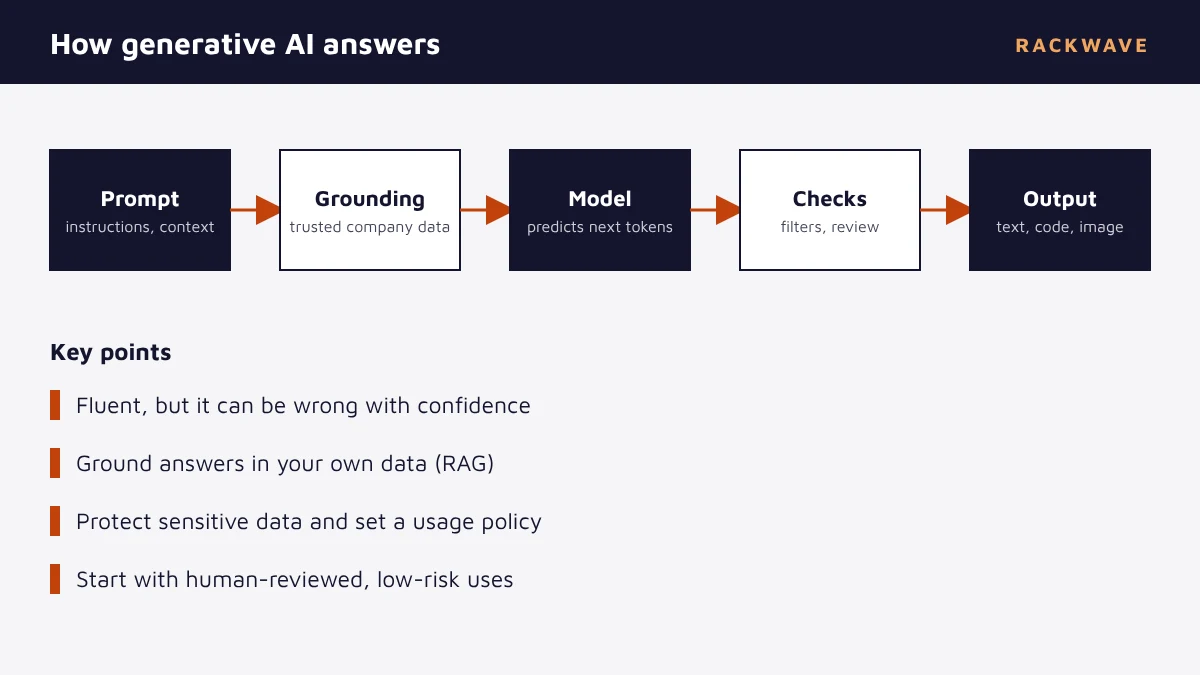
- Pre-training. A foundation model learns patterns of language or images from very large datasets by predicting missing or next pieces.
- Adaptation. The model is refined with extra training, instructions or human feedback so it follows requests and behaves safely.
- Prompting. A user or application supplies instructions and context, called a prompt.
- Grounding. The application adds trusted data, such as company documents or records, so the answer is based on facts.
- Generation. The model produces output one token at a time, choosing likely continuations.
- Checks. Filters, rules and human review guard quality and safety.
Large language models, in plain terms
A large language model, or LLM, is a neural network trained on enormous amounts of text. It represents words as numbers, learns relationships between them and uses them to predict the next token in a sequence. With enough training and the right design it can answer questions, summarise, translate, classify and write code. It does not "look up" answers. It generates a plausible continuation, which is why it can be fluent and wrong at the same time.
Types of generative AI
| Type | Creates | Business example |
|---|---|---|
| Text | Drafts, summaries, answers, translations | Drafting customer replies, summarising cases |
| Code | Source code, tests, explanations | Developer assistants |
| Image | Pictures and designs | Marketing visuals and concept art |
| Audio and speech | Voice, music, transcription | Voice assistants, meeting notes |
| Video | Short clips and edits | Product demos, training content |
| Structured data | Synthetic datasets, tables | Test data when real data is sensitive |
Generative AI vs traditional AI
| Factor | Traditional (predictive) AI | Generative AI |
|---|---|---|
| Output | A label, score or number | New content |
| Training data | Often specific, labelled business data | Very large general datasets, then adapted |
| Typical task | Classify, forecast, detect | Draft, summarise, converse, create |
| Main risk | Bias and drift | Hallucination, leakage and misuse |
| Evaluation | Accuracy metrics | Quality, factuality and safety checks |
Practical business uses
- Customer service: suggest or draft replies, summarise long cases and power assistants grounded in your knowledge base.
- Sales: summarise accounts, prepare call notes and draft outreach.
- Marketing: produce first drafts, variants for testing and localised copy, reviewed by people.
- Knowledge work: search and summarise internal documents and policies.
- Software engineering: generate code, tests and documentation.
- Operations: extract data from documents, such as invoices and contracts.
Platforms now bring these capabilities into existing tools. For an example in CRM, see Salesforce Agentforce and Einstein AI.
Treat generative AI as a very fast, very confident junior colleague. Useful for drafts, dangerous without review.
Prompting basics
The quality of the output depends heavily on the quality of the prompt. State the role and the task, give the context the model needs, specify the format of the answer, and include an example if the pattern is unusual. Ask the model to say when it does not know, and to cite the source passages it used. For repeatable work, save good prompts as templates and test them on a set of real examples, since small changes in wording can change results. Treat prompts as part of your system, with owners and version control, not as personal tricks.
The main risks and how to manage them
| Risk | What happens | Mitigation |
|---|---|---|
| Hallucination | The model states false things confidently | Ground answers in trusted data, require citations, review important output |
| Data leakage | Sensitive data is sent to or retained by a third party | Use enterprise terms with no training on your data, mask personal data, restrict inputs |
| Bias and harmful output | Unfair or inappropriate content | Test, filter and monitor outputs |
| Intellectual property | Unclear ownership or similarity to existing works | Review terms, avoid sensitive uses, check output |
| Prompt injection | Malicious instructions hidden in content the model reads | Limit tool access, validate inputs and outputs, keep humans in the loop |
| Over-reliance | People accept output without checking | Training, review steps and clear accountability |
Retrieval-augmented generation (RAG)
RAG is a common way to make generative AI accurate about your own information. Instead of relying only on what the model learned in training, the system first searches your documents or data for relevant passages, adds them to the prompt and asks the model to answer from them. This reduces hallucination, keeps answers current without retraining and respects permissions if the search honours them. The quality of RAG depends on the quality, structure and freshness of your content, so knowledge management and data quality matter as much as the model.
How to adopt generative AI safely
- Write a usage policy. State what data may be used, which tools are approved and what must be reviewed by a person.
- Choose high-value, low-risk starting points. Drafting and summarising with human review are better first steps than fully automated decisions.
- Prepare your data and content. Clean, organise and secure the knowledge the system will use.
- Select tools with enterprise controls. Check data handling, security certifications, access control and audit logging.
- Pilot and measure. Compare time saved and quality against a baseline, and collect user feedback.
- Train people. Teach good prompting, verification habits and the limits of the tools.
- Monitor and improve. Review outputs, incidents and cost, and refine prompts, data and guardrails.
Practical tip: Start with questions your team already asks every week, such as "what is our policy on X" or "summarise this account". Measure how often the answer is right and how long review takes before you extend to anything customer-facing.
Generative AI and system integration
The model is only part of the solution. Real value comes when it can read the right data and take actions in business systems, which depends on APIs, permissions and orchestration. Plan the integration layer early. See our guides to what is an API and what is system integration. Our AI and machine learning services and system integration service help organisations connect generative AI safely to their data and processes.
Key takeaways
- Generative AI creates new content by predicting likely continuations learned from large datasets.
- LLMs power text and code tools; they are fluent but can be wrong.
- Ground answers in trusted data using techniques such as RAG.
- Manage hallucination, data leakage, bias and prompt injection with policy and design.
- Start with low-risk, human-reviewed uses and measure the results.
Quick glossary
| Term | Meaning |
|---|---|
| LLM | Large language model trained on large amounts of text |
| Prompt | The instructions and context given to a model |
| Token | A small unit of text a model reads or writes |
| RAG | Retrieval-augmented generation, using retrieved documents to ground answers |
| Hallucination | Confident but incorrect output |
Read next: Lead Nurturing: Strategy, Tactics and Examples · Data Quality: Dimensions, Causes and How to Improve It · What Is a Data Pipeline? Components, Types and Examples
Frequently asked questions
What is generative AI in simple terms?
Generative AI is artificial intelligence that creates new content, such as text, images, code or audio, based on patterns it learned from large amounts of existing data.
How does generative AI work?
A model is trained on very large datasets to learn patterns, then generates new output by predicting likely next pieces in response to a prompt. Grounding and review improve accuracy and safety.
What is the difference between generative AI and traditional AI?
Traditional AI usually classifies or predicts, for example detecting fraud. Generative AI produces new content, such as drafting text or creating images.
What is an LLM?
A large language model is a neural network trained on large amounts of text to predict the next word or token, which lets it answer questions, summarise, translate and write code.
What is a hallucination in AI?
A hallucination is an output that sounds plausible but is false or unsupported. It happens because models generate likely text rather than retrieving verified facts.
Is generative AI safe for business data?
It can be, if you use tools with enterprise data controls, avoid sending sensitive data to unapproved services, mask personal information and apply access controls and logging.
What is RAG?
Retrieval-augmented generation first searches your own documents or data for relevant information, then gives it to the model so the answer is grounded in your content.
What are good first use cases for generative AI?
Drafting and summarising with human review, such as case summaries, internal knowledge search, first drafts of content and code assistance, are good, lower-risk starting points.